Posts mit dem Label money laundering werden angezeigt. Alle Posts anzeigen

Montag, 18. Juni 2012

Stanford Officer to Plead Guilty

John Ellis Bush June 18, 2012
By VANESSA O'CONNELL

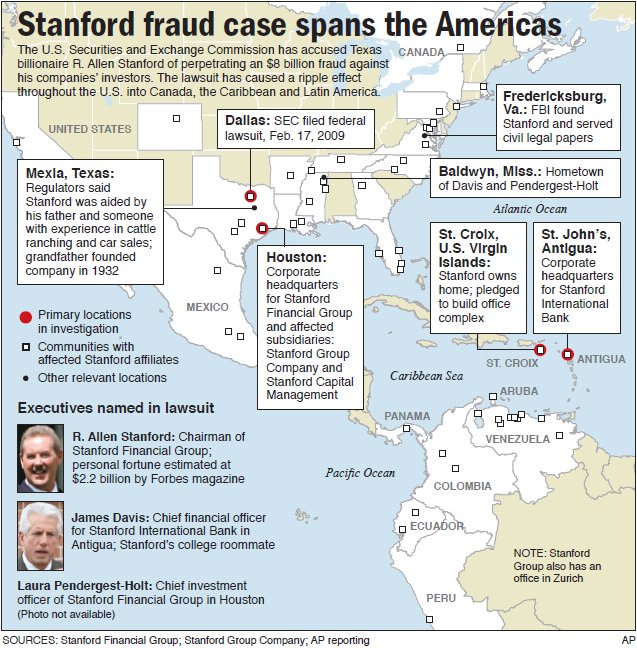
Stanford Financial Group's top investment executive, Laura Pendergest-Holt, is expected to plead guilty to obstruction of justice Thursday for her alleged role in a $7 billion Ponzi scheme that was among the largest frauds in U.S. history, a person familiar with the case said.

A spokeswoman for the Justice Department declined comment.

The expected plea by Ms. Pendergest-Holt, Stanford's chief investment officer, follows the sentencing last week of convicted Ponzi schemer R. Allen Stanford to 110 years in prison.

That punishment amounts to a life sentence for Mr. Stanford, 62 years old, who for years enjoyed the life of a billionaire aboard jets, yachts and in homes around the globe.

He remains in federal custody until the U.S. Bureau of Prisons decides where he will serve the time.
Laura Pendergest-Holt
A Federal Bureau of Investigation affidavit filed in U.S. District Court in Dallas had alleged that Ms. Pendergest-Holt misled Securities and Exchange Commission investigators who took her testimony in the probe of alleged fraud at Stanford International Bank, Mr. Stanford's Antigua-based offshore bank.

Ms. Pendergest-Holt was scheduled to go on trial in September.

An obstruction charge can carry a three-year sentence.

Read more: http://sivg.org/article/2012_Stanford_Officer_Plead_Guilty.html


Visit the Stanford International Victims Group - SIVG official forum http://sivg.org/forum/

Donnerstag, 14. Juni 2012

Stanford sentenced to 110 years over Ponzi scheme

June 14, 2012
By The Wall Street Journal
R. Allen Stanford, the once-highflying financier convicted of masterminding a $7 billion Ponzi scheme, was sentenced Thursday to 110 years in federal prison.

The punishment amounts to an effective life sentence for Stanford, who is 62 years old and used to live extravagantly aboard yachts, jets and homes around the world.

"I didn't run a Ponzi scheme, I didn't defraud anybody and there was never any intent to defraud anybody," Stanford, wearing a green prison jumpsuit, told US District Court Judge David Hittner before he was sentenced.

In a rambling statement, marked with long pauses as he choked up and wiped away tears, Stanford accused the government of using "Gestapo tactics" and blamed it for the billions of dollars in losses to his investors.

Stanford's sentence was 40 years less than the prison term given to Bernard Madoff, but 100 years more than his lawyers had asked for.

The sentence ends the three-year criminal prosecution of Stanford, who in March was convicted by a federal jury on 13 of 14 counts including fraud, obstructing investigators and conspiracy to commit money laundering.

Though investors continue to seek hundreds of millions of dollars from Stanford in a civil proceeding, the end of the criminal case closes a chapter on one of the most flamboyant figures in the annals of white-collar crime.

Read more: http://sivg.org/article/2012_Stanford_sentenced_to_110_years.html


Visit the Stanford International Victims Group - SIVG official forum http://sivg.org/forum/

Montag, 14. Mai 2012

Investors Sue Auditor BDO for Stanford Ponzi Fraud

May 14, 2012
By DAVID LEE
Investors defrauded by Allen Stanford's $7 billion Ponzi scheme say in court that the fund's auditor knowingly participated in the fraud.

The Official Stanford Investors Committee filed the federal complaint against BDO USA, and related entities BDO International, BDO Global Coordination and Brussels Worldwide Services. The complaint abbreviates Stanford Group Co. as SGC.

"Despite the pervasive fraud that infected Stanford Financial Group's operations, BDO USA repeatedly issued unqualified audit opinions on its Stanford clients' annual financial statements," the complaint states. "BDO USA's audit opinions on SGC's financial statements were critical to Stanford Financial Group's success."

In March, Stanford was found guilty of one count of conspiracy to commit mail fraud, four counts of wire fraud, five counts of mail fraud, one count of conspiracy to obstruct a U.S. Securities and Exchange Commission investigation, and one count of obstruction of an SEC proceeding. He was acquitted of one wire fraud charge.

"Allen Stanford and his co-conspirators used the promise of SIBL CDs to lure investor money into Stanford Financial Group and then stole billions of dollars in assets from Stanford Financial Group companies for their own personal benefit," the complaint states, abbreviating Stanford International Bank Ltd. certificates of deposit.

"Substantial sums of these stolen funds were used to: (i) support the lavish lifestyles of Allen Stanford and his Ponzi insiders; (ii) issue bogus, unsecured personal "loans" to Allen Stanford; (iii) capitalize other entities wholly owned by Allen Stanford; and (iv) fund investments in speculative, illiquid, and high-risk assets, including private equity holdings and massive investments in Antiguan real estate."

Investors say BDO USA provided critical services to Stanford Financial Group for over a decade, auditing the annual financial statements of Stanford Group Co., a Houston-based broker-dealer and investment adviser that recommended and sold SIBL CDs to investor.

BDO USA also allegedly audited the annual financial statements of Stanford Trust Company (Louisiana), which served as trustee and custodian to hold the SIBL CDs that SGC sold for its investors' IRA accounts. And it audited the annual financial statements of Stanford Group Holdings, a holding company for the broker-dealer arm of Stanford Financial Group, including SGC and STC, according to the complaint.

BDO allegedly played a significant role in weakening banking laws in Antigua, where SIBL was based. When Antigua came under increased scrutiny from foreign regulators, Stanford formed a task force to rewrite the country's banking laws, according to the complaint.

The task force allegedly succeeded both in weakening regulations, and in effectively eliminating SIBL's Antiguan competitors, making Stanford the country's de facto offshore banking regulator.

"The smashing success of the Stanford task force and its misleading regulatory 'reforms' were rooted in its exclusive nine-person membership," the complaint states. "Every firm represented on the Task Force provided crucial services to Stanford Financial Group, and every individual member of the Task Force was personally appointed by Stanford himself. ... BDO USA's partners and associates comprised nearly half of the Stanford Task Force's members, more than any other firm represented on the Task Force."

The key initiative of the task force was to amend Antigua's Money Laundering Act to ensure that "fraud" and "false accounting" were not included as violations, investors say.

BDO USA allegedly had some of the most important responsibilities in completing the initiative, including reviewing and advising on Antigua's banking laws, and making recommendations to Antigua's regulatory authorities, including procedures for supervising and examining international banks.

BDO USA's service on the task force completely undermined its independence from SFG and, and as a result, violated generally accepted auditing standards by issuing unqualified audit opinions on its Stanford clients' annual financial statements during the years that BDO USA served on the Stanford Task Force, the complaint says.

Investors also accuse BDO USA's audit engagement partner, Carlos Ancira, of concealing critical, material information from his own audit engagement team.

"Ancira knew that SGC was under increasing scrutiny from the SEC years before the U.S. Government seized Stanford Financial Group in February 2009," the complaint states. "Shockingly, however, Ancira reassured SGC in a February 28, 2007 email that '[d]ue to the sensitivity of the situation,' no other members of BDO USA's audit engagement team would be told about the SEC's investigation of SGC for possible securities fraud. Furthermore, Ancira's email permitted SGC's outside legal counsel to omit any discussion of the SEC investigation in its audit response letter."

For every year BDO USA audited SGC's annual financial statements, it failed to confirm that SGC remitted investor funds to purchase SIBL CDs and failed to properly modify its audit opinions, the complaint alleged. It also stated that BDO USA failed to properly consider and apply consolidation principles, failed in its role as a public watchdog and issued unqualified audit opinions in spite of knowing its Stanford clients "substantially" depended on SIBL CDs.

The investors seek actual and punitive damages for negligence, civil conspiracy, breach of fiduciary duty, fraud and conversion. They are represented by Guy Hohmann with Hohmann, Taube & Summers in Austin.
PLAINTIFFS' ORIGINAL CLASS ACTION COMPLAINT
Read the complete CLASS ACTION COMPLAINT here!


Read more: http://sivg.org/article/2012_Investors_Sue_Auditor_BDO.html


Visit the Stanford International Victims Group - SIVG official forum http://sivg.org/forum/

Mittwoch, 18. April 2012

TD Bank says "copying error" caused altered document in fraud-money laundering case; but victim says that's nonsense

April 18, 2012
By ACFCS Staff
The case in which TD Bank has already lost a precedent-setting verdict for "aiding and abetting fraud" arising from collusion with one of its customers to defraud numerous persons and to launder the proceeds has taken an ugly turn.

A 70-day trial that ended in January produced a $67 million victory for Coquina Investments in its civil suit against TD Bank. Coquina was a victim of a megafraud perpetrated by TD Bank customer, Scott Rothstein, a convicted former lawyer now serving a 50-year prison term. The bank has appealed the verdict.

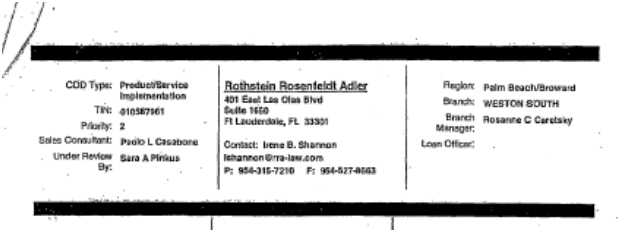
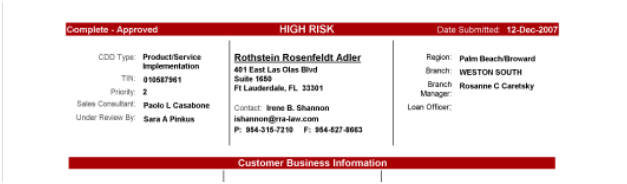
But now, TD Bank, one of the world's largest banks, confronts explosive post-trial charges that it produced a fraudulent piece of evidence at the trial that falsely hid its internal assessment that Rothstein and his firm were a "high risk" for money laundering.

The evidence, a 2009 TD Bank document called a "Customer Due Diligence" form, contained the findings of the pre-account opening inquiry by the bank of Rothstein's firm, Rothstein, Rosenfeldt and Adler.

Coquina Investments, the fraud victim that won the unprecedented verdict, alleged on March 26 that the bank perpetrated a "fraud on the court and jury" by hiding a red banner that contained the all-upper-case words "HIGH RISK."

The accusation, in the form of a motion for sanctions filed by Coquina's lead lawyer, David Mandel, of the Miami firm, Mandel & Mandel, alleges that TD Bank and its lawyers at Greenberg Traurig intentionally altered the form to keep the jury from seeing the official designation of Rothstein's law firm as "high risk."

TD Bank says altered form did not hurt plaintiff's case

TD responded to the accusation on April 12, denying any intention to mislead the jury. It said the alteration of the form resulted from a "copying error" by clerical staff and that Mandel knew of the high risk designation and stressed that to the jury in his closing argument. The bank said the altered form did not significantly influence the jury or change the trial's outcome, which was favorable to Coquina in any event.

Mandel countered with a strongly-worded reply on April 16, saying the bank's "response is tantamount to a continuing fraud on the court." He said TD Bank's explanation that its "copying process" was to blame for the doctored document "is not credible and can't be replicated."

He said "the trial would have proceeded much differently had the defendant produced the true document." Coquina's $67 million verdict included $35 million in punitive damages. Mandel had asked the jury to award $140 million in punitive damages.

With true form in hand, jury may have awarded higher damages

"Coquina is unfairly left to wonder what the jury's punitive damages award might have been if [TD Bank] had produced an unaltered version of the document before trial," says Mandel.

"The integrity of our judicial system demands that [TD Bank's] actions have consequences," he added.

Mandel said the bank not only introduced "the altered document into evidence," but also "affirmatively used it, both to cross-examine Coquina's expert and in closing argument." The bank, he says, "insisted that (Rothstein's firm) was a Low Risk customer" and berated Coquina's expert for asserting otherwise.

He alluded to a federal law at Title 18 USC, Section 1512(c)(1), which makes it a criminal offense to intentionally alter a document for use in a trial.

"Unreasonable" to believe alteration was accidental, Mandel says

The version of the Customer Due Diligence form the bank introduced in evidence had a simple black bar as a heading. Mandel says the true form, which he obtained in another case in which TD Bank is being sued, contains the words "HIGH RISK" emblazoned across the top, highlighted by a red background.

He says the alteration was so obvious and egregious that it had to be deliberate and that the misleading form propped up TD's defense that it knew nothing of Rothstein's fraud, did not help him perpetrate it and viewed his law firm as low risk.

"With tens of millions of dollars on the line, the Defendant asks the Court to believe... that it accidentally altered the document and presented it to the jury in a fashion that was undeniably misleading," says Mandel. He calls the argument "nonsense."

TD Bank denies bad faith

The bank's April 12 response denies it acted in "bad faith" and says changes to the form were unintentional by unnamed administrative staff.

The bank submitted a signed declaration by Sara Pinkus, a risk officer who had been asked to "gather customer due diligence records" to send to Greenberg Traurig for the trial. Pinkus says she printed the form and turned it over to an assistant for photocopying. The form was sent to the law firm, where a clerical assistant scanned the form and converted it to electronic format.

The bank says "the printing and copying process inadvertently blackened all of the words in all of the colored headers of the [form]," including the "HIGH RISK" designation.

Mandel calls this explanation "insufficient, inaccurate and potentially perjurious."

"Coquina attempted to replicate the Defendant's "copying process," but none of our efforts resulted in the words HIGH RISK being obscured from the document." he adds.

TD Bank declined requests for comment by ACFCS.org, citing its policy of not commenting on "pending litigation."

TD Bank says it "sincerely regrets this copying error," but contends that the obliterated "HIGH RISK" heading had no impact on Coquina's presentation at trial.

TD Bank's laundering expert testified Rothstein's firm was not "high risk"

TD Bank's response is silent on why Ivan Garces, who was TD Bank's anti-money laundering trial expert, testified that Rothstein was not a high-risk customer when its Customer Due Diligence form labeled him as such. Garces' had this colloquy at trial with a lawyer in Mandel's firm:

Coquina lawyer: Now is it - it's your opinion, sir, that TD Bank did not consider RRA [Rothstein's law firm] to be a high-risk customer of the bank; is that right?
Garces: Yes, ma'am. That's correct.
Coquina lawyer: It's not a high-risk customer.
Garces: It did not consider it a high-risk customer.

Mandel says in his new reply that "if the true document had been produced and entered into evidence..., it is hard to imagine anyone brazen enough to claim that [TD Bank] did not consider [Rothstein's law firm] to be a HIGH RISK customer."

Call for sanctions includes referral to Justice Department, Florida Bar

Mandel has requested that US District Court Judge Marcia G. Cooke impose a series of sanctions, including referring TD Bank to the US Department of Justice for criminal investigation and referral of Greenberg Traurig to the Florida Bar for review of possible ethical violations.

Judge Cooke, who presided over the long trial, has not yet acted on the motion, which requests sanctions.

The case offers many anti-money laundering and fraud control lessons to financial institutions. The experience of TD Bank also plants the seeds of headaches for financial institutions whose employee compensation plans include bonuses for attracting "assets under management."

(The two versions of the top part of TD Bank's Customer Due Diligence Form for Rothstein's defunct law firm, Rothstein, Rosenfeldt and Adler, follow. The version presented in the Coquina case appears first, followed by the unaltered version.)

False Customer Due Diligence Form

TD Bank Customer Due Diligence Form

Read more: http://sivg.org/article/2012_TD_Bank_says_copying_error.html


Visit the Stanford International Victims Group - SIVG official forum http://sivg.org/forum/

Mittwoch, 21. März 2012

Allen Stanford, American Drug Lord

Stanford Drug Lord March 21, 2012
By dhopsicker

Missing from coverage of the conviction two weeks ago of Texas "financier" Allen Stanford for running a $7 billion Ponzi scheme was any mention of Stanford's long-time role as an authentic-if no longer certified-American Drug Lord.

"Sir" Allen (the title was bought) is an excellent example of a curiously under-publicized species: the American Drug Lord.
Texas billionaire Allen Stanford
(The U.S. Drug Enforcement Administration claims the species doesn't even exist; it may be they have their own reasons.)

To most observers in the Caribbean, however, Stanford's narco-bank was as visible a manifestation of the global drug trade as a homemade semi-submersible submarine, or a convoy of SUV's snaking through Sinaloa's Sierra Madre Mountains.

Banks like his immodestly-named Stanford International Bank on the island of Antigua, where financial regulators are apparently even more easily-corrupted than their counterparts in the U.S., are as essential to global drug trafficking as fleets of late-model, preferably American-registered luxury jets.

"Every island has one," one veteran Caribbean observer told us from Kingston Jamaica, referring to Stanford's bank. "The days are mostly gone when you could walk in and lay out three suitcases of cash and get a penthouse condo on Miami Beach."

"You can't spend money you haven't first deposited in a bank these days."

It's the little things

Conspicuously missing at Stanford's trial were answers to questions widely being asked, especially in the Caribbean, where many lost their life savings, about Stanford's relationship with the CIA.

Stanford Drug Lord

Was Stanford's bank in Antigua just the latest in a long line of money-laundering banks—like Castle Bank, Nugan Hand, and Wachovia—used to move money around by the CIA and organized crime?

One telling detail: when Stanford's fellow Ponzi All-Star Art Nadel (of Huffman Aviation in Venice Florida fame) went on the lam, he lit out for Slidell, Louisiana, the legendary site of Carlos Marcello's hunting lodge just outside New Orleans.

After Stanford went on the lam he was found in Fredericksburg, Virginia, just over the hill from "The Farm," the training facility of one of the U.S. Government's most famous three-letter agencies at the Marine Corps Base in Quantico.

White kid gloves only, please

The kid-glove treatment accorded two of Stanford's accomplices is another clue to Stanford's provenance. Without their help, say observers, Stanford's operation would have been shut down as much as a decade earlier.

Both were high-level U.S. Federal Agency employees, one in the DEA, the other in the SEC, America's Securities Exchange Commission, charged with preventing financial fraud.

Stanford Drug Lord

Neither Agency has exactly covered itself in glory in living memory. In the $3 trillion financial heist in 2008, the SEC, unfortunately, got there a little late...

And in the now 40-year old War on Drugs, the DEA cannot be said to be "shock and awe-ing" the global drug trade into anything like submission.

In the aftermath of Stanford's arrest, the two former high-level Federal employees fared pretty well. One, deeply and criminally implicated by numerous sources, paid just a $50,000 fine, and never even faced criminal charges.

And when the second one did face criminal charges, a miracle occurred.
Thomas Raffanello
The 'Immaculate Acquittal'


It's morning in Miami. Tuesday the 10th of February, 2010. Inside the Federal Courthouse downtown something extremely rare is about to take place: a miracle, at least the closest thing to a miracle veteran court-watchers have seen in a long time.

It comes at the end of the trial of Thomas Raffanello, Allen Stanford's Chief of Security, and the long-time chief of the Drug Enforcement Administration's Miami office. Before joining Stanford, Raffanello led investigations against Manuel Noriega and the Medellin Cartel.
Thomas Raffanello
There has long been speculation about Stanford's connections with the world of "los narcos." But Raffanello is the one verifiable link between Allen Stanford and the global drug trade.

Raffanello, accused of illegally shredding documents at Stanford Financial Group after Stanford's arrest, was taken to a Fort Lauderdale federal courtroom in shackles, facing charges of conspiracy, obstruction of justice and destroying records.

But he had committed no crime, his lawyers said in a court filing. He was simply taking out the garbage.

On the morning of February 10, 2010, Raffanello sat in court awaiting the jury's verdict as the jury asked for clarification on one of the charges. Then, after they retired to continue their deliberations, Judge Richard Goldberg ordered the charges dismissed.

Lawyers called the ruling extremely rare, almost unprecedented. "Something smells here," said one courtroom observer afterwards.

It was the Immaculate Acquittal.

"Judges always wait for the jury to finish deliberations. If the jury finds the defendant not guilty, case closed. If they find him guilty, the judge has the power to over turn the conviction. But in that case the judge proclaims, Judgment notwithstanding the verdict."

"We witnessed a miracle," said one of Raffanello's defense attorneys, Janice Burton Sharpstein.
Barry Seal
It's a small world, after all

Sharpstein is married to Richard Sharpstein, a Miami attorney who represented one of the trigger men in the assassination of Barry Seal in Baton Rouge Louisiana in 1986.

We interviewed him while researching "Barry & the Boys." But the story he told us speaks volumes about the world of Allen Stanford.

"Why was Barry Seal murdered?" we asked.

"Seal had been irate when the IRS seized all his property," Sharstein related. "The IRS man said to Seal, ‘You owe us $30 million for the money you made drug smuggling."
Thomas Raffanello "Hey, I work for you," was Seal's reply. "We both work for the same people."

"You don't work for us," the IRS agent replied. "We're the IRS."

"Then Unglesby (Seal's attorney) watched as Seal place a call to (then-Vice President) George Bush," Sharpstein stated.

"He heard Barry say, If you don't get these assholes off my back I'm going to blow the whistle on the Contra scheme."

"What Unglesby says is, That's why he's dead.

Allen Stanford isn't dead. But he pissed somebody off bad enough to make him wish he were.

Read more: http://sivg.org/article/2012_Allen_Stanford_American_Drug_Lord.html


Visit the Stanford International Victims Group - SIVG official forum http://sivg.org/forum/

Dienstag, 6. März 2012

Jury convicts R. Allen Stanford in investor fraud

March 6, 2012
By Loren Steffy
A federal court jury on Tuesday convicted Texan R. Allen Stanford of all but one count of an indictment alleging he ran a $7 billion fraud through an offshore bank.

Stanford, a Mexia native, was convicted of 13 counts of conspiracy, fraud, obstruction and money laundering. The counts of which he was found guilty carry total penalties of 230 years.

Stanford, 61, sat with his hands clasped over his mouth as he awaited the verdict, then looked to family members in the courtroom as U.S. District Judge David Hittner read the 13 verdicts of guilty and one of not guilty.

Evelyn Saravia, a friend of Stanford who has been in court every day since the trial began Jan. 23, wept as the verdicts were read, and family members wiped tears.

The 8-man, 4-woman jury acquitted Stanford of a wire fraud count alleging he bought Super Bowl tickets for co-defendant Leroy King, a regulator in the Caribbean nation of Antigua who is set for trial later.

On Monday, the jurors asked to review testimony about rules regarding gifts to Antiguan regulators, then told the court they were unable to reach a unanimous verdict on all counts.

Hittner ordered them to keep deliberating, and they reached the verdict after about 90 minutes of deliberations Tuesday morning.

Stanford Caption
Convicted Texan R. Allen Stanford
They broke for lunch, then returned to the courtroom at 1:30 p.m. Tuesday to consider a forfeiture matter they weren't aware of until after they returned the verdict.

The government asked jurors to find that in view of his conviction, Stanford must forfeit 29 bank accounts the government alleges contain investor money.

The jurors heard testimony on that matter Tuesday afternoon, and will deliberate it Wednesday.

Defense lawyer Ali Fazel said the defense team is disappointed in the guilty verdicts and plans to appeal.

Asked about Stanford's state of mind, defense lawyer Robert Scardino said, "He would be unusual, I think, if he was anything but depressed. It was a long, hard case and of course the consequences for Stanford are going to be dire."

Hittner did not immediately set a sentencing date for Stanford.

He has been jailed without bond as a flight risk since he was indicted in June 2009, four months after the Securities and Exchange Commission filed a fraud suit and shut down his international financial network, all part of Houston-based Stanford Financial Group.

The government alleged that Stanford and others defrauded investors in certificates of deposit issued by Stanford International Bank in Antigua.

Stanford declined to testify in the case, on the advice of lawyers.

The jury convicted Stanford on one count of conspiracy to commit mail or wire fraud; four counts of wire fraud; five counts of mail fraud; one count of conspiracy to obstruct a U.S. Securities and Exchange Commission proceeding; one of obstructing an SEC proceeding; and one of conspiracy to commit money laundering.

The government's star witness was Stanford's former chief financial officer, James Davis, who has pleaded guilty for his role in the scheme. Evidence included documents showing that potential customers were attracted by the offshore bank's higher rates of interest and guarantees of "safe and conservative" investments, from 1990 until federal regulators shut it down on Feb. 17, 2009.

Other key evidence came from FBI agent Robert Martin, who once worked as a banking officer. He showed jurors weeks ago how government investigators traced funds from the bank to a secret Swiss bank controlled by Stanford. From there, some of the money went to King and to an auditor, who signed off on the bank's annual report numbers, as well to other Stanford bank accounts in Houston and Florida.

By the time federal regulators shut down Stanford's enterprise, the government claims, Stanford had taken more than $2 billion from the offshore bank in loans.

Federal prosecutors said Stanford was taking $1 million a day out of the Antigua bank by the end of 2008.
Allen Stanford
Convicted Texan R. Allen Stanford

Read more: http://sivg.org/article/2012_Jury_convicts_Allen_Stanford.html


Visit the Stanford International Victims Group - SIVG official forum http://sivg.org/forum/

Samstag, 28. Januar 2012

Stanford Told Investors "Lie After Lie" and now he is trying to "game the system"

January 28, 2012
Stanford's lawyer told the panel that the CDs sold by the Stanford bank weren't securities and that Stanford's clients had no say over how their money was invested.

Robert Scardino, one of Stanford's court-appointed lawyers called those CD purchasers "sophisticated investors" whom he said "know what a CD was and what it wasn't."

They also received promotional materials from Stanford's business disclosing that past performance was no guarantee of future success and that an investor could lose the entirety of an investment.

Well, it seems Scardino and defense lawyer Ali Fazel should look at these promotional materials from Stanford's business!
Stanford promotional material
Gregg Costa, the lead federal prosecutor, has said that Mr. Stanford is trying to "game the system."

"You're still pushing that?" Judge Hittner responded incredulously when he heard from the defense lawyers that Mr. Stanford was unable to participate fully in his defense.

Read more: http://sivg.org/article/2012_Stanford_promotional_material.html


Visit the Stanford International Victims Group - SIVG official forum http://sivg.org/forum/

Montag, 5. Dezember 2011

US-Committee in opposition to Grant Thornton

December 5, 2011
By the US-Committee
The Official Stanford Investors Committee (the "Investors Committee") submits this brief in opposition to the Petition for Recognition of Foreign Main Proceeding Pursuant to Chapter 15 of Bankruptcy Code (the "Petition"). The Petition was originally filed by former liquidators, Nigel Hamilton-Smith and Peter Wastell, and is now championed by Marcus Wide and Hugh Dickson (the "Joint Liquidators").

The Investors Committee respectfully urges the Court to deny the Joint Liquidators any form of recognition under Chapter 15. Any recognition of these Joint Liquidators would be "manifestly contrary to the public policy of the United States". That is so for at least four separate reasons.

First, the appointment of the Joint Liquidators (and their predecessors) was pursued and obtained in violation of this Court's Orders. Granting these Joint Liquidators any form of Chapter 15 recognition, under these circumstances, would undermine fundamental regulatory and jurisdictional policies of the United States.

Second, there are significant conflicts of interest raised by the Joint Liquidators's request for recognition as the "foreign main" proceeding. The Receivership Estate has significant claims against the Antiguan government that will likely be frustrated (or abandoned) if the Joint Liquidators achieve "foreign main" recognition. The Investors Committee believes those conflicts are exacerbated by the multiple representations that have been undertaken in this proceeding by counsel for the Joint Liquidators.

Third, the recognition sought by the Joint Liquidators should be denied because it is very much a "one-way street." The Antiguan courts have already refused to recognize this Court's Receiver, finding both that the Receiver has "no legal entitlement to standing in Antigua and Barbuda" and that this Court's Order appointing the Receiver and taking sole possession of the assets of the various Stanford entities, including SIBL, was "unenforceable."

Fourth, recognition should be denied because it has become painfully obvious that the Antiguan government and the Antiguan judicial system have no real interest in prosecuting the individuals responsible for the Stanford fraud, nor in recovering assets for the benefit of Stanford's investor-victims.


Visit the Stanford International Victims Group - SIVG official forum http://sivg.org/forum/

Mittwoch, 17. August 2011

Consolidated Reply to Responses by SEC and Co.

August 17, 2011
By KACHROO LEGAL SERVICES, P.C.
No one has disputed in their oppositions that the Investor Committee lacks a majority of independent and disinterested investors, which is necessary to adequately represent the interests of investors. To the contrary, the Investor Committee admits that three of its non-investor attorney members have substantial contingency fee agreements with the Receiver, and that the non-investor Examiner is paid out of the receivership estate - resulting in a situation where four of the seven members are interested.

Additionally, a fifth member, an attorney, is not an investor. The Movants seek intervention based on the simple and uncontroversial principle that the Investor Committee should be comprised of at least a majority of disinterested investors.

The motion should be granted on this basis alone.

Rather than substantively address this concern and reassure investors that they are in fact adequately representing their interests, the Investor Committee prefers to attack Movants' counsel in a personal and, frankly, inaccurate character assassination, for which they should be ashamed. The fact that the Investor Committee is seeking to repel rather than welcome independent support and help is very telling.

To their credit, the SEC and the Receiver did not engage in personal attacks, but also did not address the principal concern: whether the receivership is adding value to the estate for investors.

One of the concerns raised by Movants in their motion was a 25% contingency fee agreement with attorneys on the Investor Committee (representing the receivership and essentially therefore all investors), that could generate hundreds of millions of dollars in attorneys' fees, in cases that the Receiver has already investigated and developed, and with no provision for judicial review or approval of the appropriateness of the fees in relation to the work performed...
FOR IMMEDIATE RELEASE! Source.


Visit the Stanford International Victims Group - SIVG official forum http://sivg.org/forum/

Samstag, 30. Juli 2011

Response and Objection to the KLS Motion to Intervene

July 30, 2011
The Motion to Intervene filed by the KLS Stanford Victims should be denied. While styled as a Motion to Intervene (and for the appointement of four additional Stanford investors to the Committee), the Motion is little more than an attempt by one lawyer - Gaytri Kachroo ("Kachroo") - to belatedly insert herself into these proceedings, principally in order to influence defrauded Stanford investors to hire her firm to sue the United States government, but also in an effort to circumvent prior orders of this Court which established and govern the conduct of the Committee.

The Motion should be denied for at least each of the following reasons (any one of which would alone support denial):

A. This Court has uniformly denied all of the numerous previous requests (during this two-and-a-half-year old case) by individual Stanford investors, and groups of investors, to intervene, and instead determined to appoint the Examiner and the Committee to represent the interests of investors in these proceedings, all through carefully crafted orders entered after notice and an opportunity to be heard by Movants and all other Stanford investors and their representatives. Neither Kachroo nor any member of the KLS Group (nor any other Stanford investor for that matter) filed any objections to, or appeals from, any of the relevant orders about which she now belatedly complains, but all of which became final and non-appealable long ago. In fact, no investors filed objections to entry of any of the orders which established the Committee, entrusted it with broad powers to investigate and prosecute claims on behalf of investors and the Receivership estates, and named the Examiner;

B. Even considering Kachroo's request for appointment of her firm's clients to the Committee would be premature and inappropriate unless this Court were to reverse its previous practice and grant her intervention motion;

C. Granting the Motion and/or other motions to intervene at this stage of the proceedings would create chaos, delay and increase the costs of administering these cases;

D. The requested intervention would be futile because the alleged and limited grounds for which the intervention is purportedly sought have either been addressed already, or would be unaffected by the requested intervention;

E. The putative intervenors, all of whom appear to be Stanford investors, are already fully and adequately represented in these proceedings; and

F. The requested intervention is untimely.

The request by Kachroo Legal Services, P.C. to initiate an investigation attached the recently filed Motion to Intervene and Declaration based on the malfeasance and waste of the receivership which to date has consumed all collected assets, $120 million. The motion also details an inside deal between the Receiver and the Official Stanford Investor Committee which provided a pre-approved 25% percent contingency fee to attorneys on the Committee who have not objected to any of the Receiver's fees. This is despite their role of holding the receivership accountable and on track and their right to raise and be heard on any issue in the Receivership proceedings.


FOR IMMEDIATE RELEASE! Source.


Visit the Stanford International Victims Group - SIVG official forum http://sivg.org/forum/

Donnerstag, 21. Juli 2011

SEC Inspector General to Investigate Stanford Texas Receivership

July 21, 2011
By KACHROO LEGAL SERVICES, P.C.
We have learned today that SEC Inspector General David Kotz will begin an investigation of the Texas Receivership of Allen Stanford, pursuant to a request by Kachroo Legal Services, P.C.

The request by Kachroo Legal Services, P.C. to initiate an investigation attached the recently filed Motion to Intervene and Declaration based on the malfeasance and waste of the receivership which to date has consumed all collected assets, $120 million. The motion also details an inside deal between the Receiver and the Official Stanford Investor Committee which provided a pre-approved 25% percent contingency fee to attorneys on the Committee who have not objected to any of the Receiver's fees. This is despite their role of holding the receivership accountable and on track and their right to raise and be heard on any issue in the Receivership proceedings.

The Inspector General will likely investigate the SEC's failure to appropriately oversee this Receivership. The last objection concerning overbilling by the Receiver Ralph Janvey filed by the SEC was over one and one-half years ago.

For further information please contact Kachroo Legal Services, P.C. at (617) 864-0755 or email wlugo@kachroolegal.com. For further information about Kachroo Legal Services, P.C., please review our website www.kachroolegal.com.


FOR IMMEDIATE RELEASE! Source.


Visit the Stanford International Victims Group - SIVG official forum http://sivg.org/forum/

Freitag, 8. Juli 2011

Stanford Victims Refuse to be defrauded by Texas Receiver

July 8, 2011
Released by Kate Freeman
Since the SEC shut down Allen Stanford's investing and banking operations over two years ago, the receivership to help the victims recover their losses has been consuming all the assets, reveals a motion filed today by Kachroo Legal Services, P.C. and its principal, Gaytri Kachroo.

Out of a $7 billion Ponzi scheme, the receiver has collected, net of expenses just $1.5m. Whereas through January 2011 the receivership estate has paid out a massive $118.2m in expenses – but none to the investors. As a result, there remains only $1.5 million for the Stanford victims from the efforts of the Receiver, this equates to $71.42 per investor, but even this small amount will likely be consumed by the Receiver. It is clear that the Receiver has not added any substantial value to the estate, and failed in his directive.

The Stanford Investors Committee (FIC) attorneys have substantial interests in the fees they generate through contingency actions. Almost no party to this action sits completely independent of and disinterested in the assets that are recovered in this receivership. And when those assets are scarce, as in this case, their interest is sharply at odds with that of the investors.

In the motion, led by Catherine Burnell of Antigua and the U.K., Ursula Mesa of Florida and Peru, Marcelo Avila of Ecuador, and Steven Graham of Louisiana - representative of the international breadth of investment into this alleged Ponzi scheme of some $7 billion - investors state that the Receiver has taken all $120 million of the assets thus far collected by him and already existing in the estate. What is more, the attorneys who were installed on the Stanford Investor Committee and responsible for holding the Receiver accountable had in fact done a deal to make themselves a preapproved 25% on all the fraudulent conveyance cases launched by the Receivership!

To date little objection has been filed against the receivership, and finally the KLS group of investors have voiced the dissatisfaction of thousands of investors with the current Texas receiver, Janvey and the Stanford Investor Committee appointed by the courts. No party to the receivership is acting as a check on the excessive fees and expenses compared to the minimal recovery, challenging the contingency fee arrangement, the operation of the receivership and otherwise voicing concern over the ineffectiveness of this receivership. The only person objecting is Alan Stanford — the person who allegedly committed the fraud.

The motion was filed on the heels of a change in the Antiguan liquidation, which had come under similar complaint and attack and lead to the removal of the previous receivers and their substitution by Grant Thornton.
KLS STANFORD VICTIMS' MOTION TO INTERVENE AND FOR APPOINTMENT TO THE OFFICIAL STANFORD INVESTOR COMMITTEE
Movants file this motion to intervene in this proceeding and for appointment to the Committee on behalf of themselves and as representatives for investors with over 500 Stanford accounts that are part of the receivership (the "KLS Stanford Victims").

The payments provided to attorneys and the Receiver in this case do not appear to reflect any reasonable compensation for the services provided nor appear in the best interest of the receivership or the victims, upon whose behalf the receivership should benefit. Moreover, the Receiver's contingency agreements with the attorneys on the Committee create a substantial and disabling self-interest that precludes adequate, independent representation of the investors by the Committee and in this proceeding.
DECLARATION OF DR. GAYTRI D. KACHROO
In connection with the Motion to Intervene, KLS diligently reviewed the filings in this action, and other actions taken on behalf of the receivership, including the fee applications and reports by the Receiver. It appears on the basis of the pleadings and documents in this action, that the receiver has failed in his directive to "minimize expenses in furtherance of maximum and timely disbursement thereof to claimants," as ordered by the Court. The payments provided to attorneys, consultants and the Receiver in this case do not appear to reflect any reasonable compensation for the services provided nor appear in the best interests of the receivership or the victims.

The issues of the exorbitant fees and the operation of the estate, which have drained substantial recovered assets, do not appear to be adequately raised or addressed by the Official Stanford Investor Committee nor any other party to this proceeding.

As part of the Official Stanford Investor Committee, the Movants would raise these and other related issues to adequately represent the interests of Stanford investors worldwide.


Visit the Stanford International Victims Group - SIVG official forum http://sivg.org/forum/

Donnerstag, 26. Mai 2011

Allen Stanford Investors Sue His Accounting Firm

RAS indicted May 26, 2011

Nearly two years after Texas financier Allen Stanford was indicted in an alleged massive Ponzi scheme, investors have just filed a $10 billion proposed class action suit against his auditor-the giant accounting firm BDO.

The suit-filed Thursday in federal court in Dallas-says BDO did not only aid and abet the $7 billion dollar fraud...it was a "co-conspirator."
Indicted financier R. Allen Stanford, accused of leading a $7 billion investment fraud scheme.
"BDO's cozy relationship with the Stanford Financial Group was steeped in conflicts of interest and required ongoing deceptive and duplicitous manipulation of the facts to allow the Ponzi scheme's exponential growth for over a decade," the complaint says. "The result of this deception is the loss of thousands of investors' life savings."

BDO not only audited Stanford's U.S. operations, it also did critical work in Antigua, where the alleged fraud was based.

Before his indictment in 2009, Stanford told CNBC about a task force he put together-including a "major accounting firm" to rewrite Antigua's banking laws.

"Back in the early '90s, I was asked by the then-government if I would put together a civilian team of professionals, which I got," Stanford said. "Ex-FBI, ex-DEA, an ex-U.S. Attorney…a major accounting firm and others to come up with a strong, if not the strongest platform for international banking."

Authorities and investors say that platform paved the way for the fraud. Stanford has denied wrongdoing. He faces a trial currently scheduled for September 12 on 14 criminal counts.

BDO has not had a chance to respond to the suit, but for months it has been fighting a civil subpoena for documents filed by the court-appointed receiver in the SEC's lawsuit against Stanford.

In a court filing in April, BDO attorneys said the firm "has no clue as to what it may have done wrong." The filing called the subpoena "a fishing expedition."

Stanford's 30-thousand investors have so far recovered just pennies on the dollar.

PLAINTIFFS' ORIGINAL CLASS ACTION COMPLAINT

X. ACTUAL DAMAGES
113. Plaintiffs and the First Class have suffered the loss of at least $7.2 billion that was proximately caused by the wrongful conduct of BDO as described herein. Plaintiffs and the Second Class have suffered the loss of approximately $3.5 billion that was proximately caused by the wrongful conduct of BDO as described herein. BDO is jointly and severally liable to Plaintiffs and both Classes for the injuries caused by the Stanford Financial Group, including SGC, STC, SFIS, and SIBL, under Texas common law of joint and several liability, as well as under the Texas Securities Act.

Read the complete CLASS ACTION COMPLAINT here!


Visit the Stanford International Victims Group - SIVG official forum http://sivg.org/forum/

Samstag, 14. Mai 2011

SEC employee testifies she paid a price for protest

May 14, 2011
By David S. Hilzenrath
An SEC employee who fought for years to get the agency to stop an alleged massive Ponzi scheme told a House panel that she "paid a heavy price" for protesting her boss's weak approach to exposing such scams.

In prepared testimony Friday, Julie Preuitt, a longtime employee in the Securities and Exchange Commission's Fort Worth office, said she was given a letter of reprimand and in 2008 was reassigned to report to a regional director "who would at times go weeks or even months intentionally avoiding any contact with me."

She said she interpreted her transfer as an effort to drive her out of the agency, and she argued that the move was "part of a cultural problem" that continues to undermine the SEC's effectiveness.

Preuitt was called to testify before the oversight panel of the House Financial Services Committee on the SEC's failure to stop Robert Allen Stanford's alleged $7.2 billion Ponzi scheme. The SEC's bungling of the Stanford case and the alleged retaliation against Preuitt were the subject of news stories and SEC inspector general reports almost a year ago. House Republicans revisited the subject Friday against the backdrop of a largely partisan battle over how much funding the agency should receive.

Democrats have generally argued that the agency needs a substantial budget increase to prevent more big financial frauds and crises like the 2008 meltdown that left the nation's economy reeling.

Some Republicans have countered that the agency's past failures render it undeserving of such a funding boost. They have invoked such embarrassments as the SEC's failure to stop Bernard L. Madoff's Ponzi scheme and a scandal in which agency employees were viewing pornography at work.

The SEC didn't need a bigger budget or more regulations to stop Stanford's alleged scam, said Rep. Randy Neugebauer (R-Tex.), chairman of the oversight and investigations subcommittee. The problem was that "people just didn't do their job," he said.

Preuitt reviewed the Stanford Group in 1997 and concluded that its stated financial returns were "absolutely ludicrous," SEC inspector general H. David Kotz said in testimony Friday.

In the years that followed, SEC examiners repeatedly pressed the agency to investigate, but the SEC enforcement staff made little if any meaningful effort to do so, Kotz said. Senior officials in Fort Worth thought they were being judged on the number of cases they brought, and they discouraged work on cases that were not quick hits or or slam dunks, Kotz said.Despite Preuitt's pleas, the SEC did not take enforcement action against Stanford until 2009. Kotz credited the SEC with acting on lessons learned from the Stanford case. But he said the SEC acted improperly when it punished Preuitt for opposing what she considered a flawed policy.

In fall 2007, one of Preuitt's superiors announced a new type of brokerage examination, "which would consist of interviewing a few senior personnel at brokerage firms over the course of a half day while reviewing limited, if any documentation," Preuitt said in written testimony. She said she objected because the plan was "nothing short of a subversion of the core mission."

Preuitt was reprimanded, and so was another SEC official who complained about the way Preuitt was treated, Preuitt said.

The inspector general recommended that the SEC consider disciplining officials for punishing the two. Preuitt said she is unaware of any disciplinary action, and she has not been restored to her former position. Committee member Rep. Bill Posey (R-Fla.) asked SEC officials: "Have we canonized Julie Preuitt yet? . . . She should probably be running the agency."

Carlo di Florio, who heads the SEC examination program, said Preuitt showed the kind of determination the agency encourages. He said the agency is working to give her new responsibilities.

Rep. Michael E. Capuano (D-Mass.) objected to any implication that the Stanford story is an argument for loosening regulation.

The attitude that the markets will police themselves and "that somehow regulation is not necessary . . . is just wrong," Capuano said. 


Visit the Stanford International Victims Group - SIVG official forum http://sivg.org/forum/

Dienstag, 10. Mai 2011

SEC Missing Stanford Fraud Not Excused by Law

May 10, 2011
The U.S. Securities and Exchange Commission’s delay in cracking down on R. Allen Stanford’s alleged Ponzi scheme isn’t excused by a law that protects regulators’ discretionary decisions, Stanford’s investors claim.

While U.S. law may shield the agency from poor policy choices, it doesn’t protect against allegations of official misconduct and abuse of office, lawyers for the investors said today in a court filing in federal court in Dallas.

Eight Stanford investors sued the SEC in March on claims that Spencer Barasch -- the former head of the SEC’s Fort Worth- Dallas office -- allowed Stanford’s alleged fraud to flourish for years by repeatedly blocking investigations into the financier’s operations.

This case "is about misconduct, and has nothing to do with disgruntled citizens second-guessing SEC 'policy judgments'," Edward Gonzales, the investors’ lawyer, said in today’s filing. "It is discretion that may be abused, not one’s office."

The SEC seized Stanford’s operations in February 2009 on suspicion of fraud. Four months later, prosecutors indicted Stanford and three of his top officers for running what they claim was a $7 billion Ponzi scheme built on bogus certificates of deposit at Antigua-based Stanford International Bank Ltd.

Stanford Denies Wrongdoing

Stanford, who denies all wrongdoing, has been imprisoned as a flight risk until he can be tried.

Last month, the government asked a Dallas judge to throw out the investors’ lawsuit, which seeks to force the SEC to cover their losses on Stanford CDs.

The investors based much of their complaint on a 2010 report by the SEC’s inspector general, who faulted Barasch for declining to act on agency recommendations to investigate Stanford for years. The report also criticized Barasch for trying to act as Stanford’s lawyer after he left the agency in 2005.

"The unethical conduct of Spencer Barasch and negligent supervision by his superiors both make the government liable here," Gonzales said in the filing.

Barasch, who isn’t personally sued by the investors, has denied acting improperly before or after leaving the SEC. Ashley Nelly, a spokeswoman for Andrews Kurth LLP, the law firm where Barasch now works, didn’t immediately return a call seeking comment on today’s filing.

Kevin Callahan, SEC spokesman, didn’t immediately return a call or e-mail after regular business hours.

The case is Robert Juan Dartez LLC v. United States, 3:11- cv-0602, U.S. District Court, Northern District of Texas (Dallas).

The criminal case is U.S. v. Stanford, 09-cr-342, U.S. District Court, Southern District of Texas (Houston). The SEC case is Securities and Exchange Commission v. Stanford International Bank, 09-cv-298, U.S. District Court, Northern District of Texas (Dallas). 


Visit the Stanford International Victims Group - SIVG official forum http://sivg.org/forum/