Posts mit dem Label Caribbean werden angezeigt. Alle Posts anzeigen

Mittwoch, 21. März 2012

Allen Stanford, American Drug Lord

Stanford Drug Lord March 21, 2012
By dhopsicker

Missing from coverage of the conviction two weeks ago of Texas "financier" Allen Stanford for running a $7 billion Ponzi scheme was any mention of Stanford's long-time role as an authentic-if no longer certified-American Drug Lord.

"Sir" Allen (the title was bought) is an excellent example of a curiously under-publicized species: the American Drug Lord.
Texas billionaire Allen Stanford
(The U.S. Drug Enforcement Administration claims the species doesn't even exist; it may be they have their own reasons.)

To most observers in the Caribbean, however, Stanford's narco-bank was as visible a manifestation of the global drug trade as a homemade semi-submersible submarine, or a convoy of SUV's snaking through Sinaloa's Sierra Madre Mountains.

Banks like his immodestly-named Stanford International Bank on the island of Antigua, where financial regulators are apparently even more easily-corrupted than their counterparts in the U.S., are as essential to global drug trafficking as fleets of late-model, preferably American-registered luxury jets.

"Every island has one," one veteran Caribbean observer told us from Kingston Jamaica, referring to Stanford's bank. "The days are mostly gone when you could walk in and lay out three suitcases of cash and get a penthouse condo on Miami Beach."

"You can't spend money you haven't first deposited in a bank these days."

It's the little things

Conspicuously missing at Stanford's trial were answers to questions widely being asked, especially in the Caribbean, where many lost their life savings, about Stanford's relationship with the CIA.
Stanford Drug Lord

Was Stanford's bank in Antigua just the latest in a long line of money-laundering banks—like Castle Bank, Nugan Hand, and Wachovia—used to move money around by the CIA and organized crime?

One telling detail: when Stanford's fellow Ponzi All-Star Art Nadel (of Huffman Aviation in Venice Florida fame) went on the lam, he lit out for Slidell, Louisiana, the legendary site of Carlos Marcello's hunting lodge just outside New Orleans.

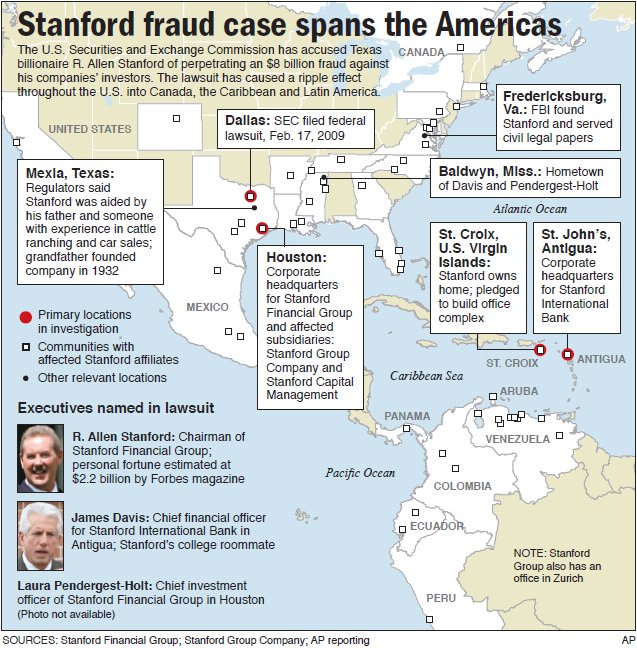
After Stanford went on the lam he was found in Fredericksburg, Virginia, just over the hill from "The Farm," the training facility of one of the U.S. Government's most famous three-letter agencies at the Marine Corps Base in Quantico.

White kid gloves only, please

The kid-glove treatment accorded two of Stanford's accomplices is another clue to Stanford's provenance. Without their help, say observers, Stanford's operation would have been shut down as much as a decade earlier.

Both were high-level U.S. Federal Agency employees, one in the DEA, the other in the SEC, America's Securities Exchange Commission, charged with preventing financial fraud.

Stanford Drug Lord

Neither Agency has exactly covered itself in glory in living memory. In the $3 trillion financial heist in 2008, the SEC, unfortunately, got there a little late...

And in the now 40-year old War on Drugs, the DEA cannot be said to be "shock and awe-ing" the global drug trade into anything like submission.

In the aftermath of Stanford's arrest, the two former high-level Federal employees fared pretty well. One, deeply and criminally implicated by numerous sources, paid just a $50,000 fine, and never even faced criminal charges.

And when the second one did face criminal charges, a miracle occurred.
Thomas Raffanello
The 'Immaculate Acquittal'


It's morning in Miami. Tuesday the 10th of February, 2010. Inside the Federal Courthouse downtown something extremely rare is about to take place: a miracle, at least the closest thing to a miracle veteran court-watchers have seen in a long time.

It comes at the end of the trial of Thomas Raffanello, Allen Stanford's Chief of Security, and the long-time chief of the Drug Enforcement Administration's Miami office. Before joining Stanford, Raffanello led investigations against Manuel Noriega and the Medellin Cartel.
Thomas Raffanello
There has long been speculation about Stanford's connections with the world of "los narcos." But Raffanello is the one verifiable link between Allen Stanford and the global drug trade.

Raffanello, accused of illegally shredding documents at Stanford Financial Group after Stanford's arrest, was taken to a Fort Lauderdale federal courtroom in shackles, facing charges of conspiracy, obstruction of justice and destroying records.

But he had committed no crime, his lawyers said in a court filing. He was simply taking out the garbage.

On the morning of February 10, 2010, Raffanello sat in court awaiting the jury's verdict as the jury asked for clarification on one of the charges. Then, after they retired to continue their deliberations, Judge Richard Goldberg ordered the charges dismissed.

Lawyers called the ruling extremely rare, almost unprecedented. "Something smells here," said one courtroom observer afterwards.

It was the Immaculate Acquittal.

"Judges always wait for the jury to finish deliberations. If the jury finds the defendant not guilty, case closed. If they find him guilty, the judge has the power to over turn the conviction. But in that case the judge proclaims, Judgment notwithstanding the verdict."

"We witnessed a miracle," said one of Raffanello's defense attorneys, Janice Burton Sharpstein.
Barry Seal
It's a small world, after all

Sharpstein is married to Richard Sharpstein, a Miami attorney who represented one of the trigger men in the assassination of Barry Seal in Baton Rouge Louisiana in 1986.

We interviewed him while researching "Barry & the Boys." But the story he told us speaks volumes about the world of Allen Stanford.

"Why was Barry Seal murdered?" we asked.

"Seal had been irate when the IRS seized all his property," Sharstein related. "The IRS man said to Seal, ‘You owe us $30 million for the money you made drug smuggling."
Thomas Raffanello "Hey, I work for you," was Seal's reply. "We both work for the same people."

"You don't work for us," the IRS agent replied. "We're the IRS."

"Then Unglesby (Seal's attorney) watched as Seal place a call to (then-Vice President) George Bush," Sharpstein stated.

"He heard Barry say, If you don't get these assholes off my back I'm going to blow the whistle on the Contra scheme."

"What Unglesby says is, That's why he's dead.

Allen Stanford isn't dead. But he pissed somebody off bad enough to make him wish he were.

Read more: http://sivg.org/article/2012_Allen_Stanford_American_Drug_Lord.html


Visit the Stanford International Victims Group - SIVG official forum http://sivg.org/forum/

Dienstag, 6. März 2012

Jury convicts R. Allen Stanford in investor fraud

March 6, 2012
By Loren Steffy
A federal court jury on Tuesday convicted Texan R. Allen Stanford of all but one count of an indictment alleging he ran a $7 billion fraud through an offshore bank.

Stanford, a Mexia native, was convicted of 13 counts of conspiracy, fraud, obstruction and money laundering. The counts of which he was found guilty carry total penalties of 230 years.

Stanford, 61, sat with his hands clasped over his mouth as he awaited the verdict, then looked to family members in the courtroom as U.S. District Judge David Hittner read the 13 verdicts of guilty and one of not guilty.

Evelyn Saravia, a friend of Stanford who has been in court every day since the trial began Jan. 23, wept as the verdicts were read, and family members wiped tears.

The 8-man, 4-woman jury acquitted Stanford of a wire fraud count alleging he bought Super Bowl tickets for co-defendant Leroy King, a regulator in the Caribbean nation of Antigua who is set for trial later.

On Monday, the jurors asked to review testimony about rules regarding gifts to Antiguan regulators, then told the court they were unable to reach a unanimous verdict on all counts.

Hittner ordered them to keep deliberating, and they reached the verdict after about 90 minutes of deliberations Tuesday morning.

Stanford Caption
Convicted Texan R. Allen Stanford
They broke for lunch, then returned to the courtroom at 1:30 p.m. Tuesday to consider a forfeiture matter they weren't aware of until after they returned the verdict.

The government asked jurors to find that in view of his conviction, Stanford must forfeit 29 bank accounts the government alleges contain investor money.

The jurors heard testimony on that matter Tuesday afternoon, and will deliberate it Wednesday.

Defense lawyer Ali Fazel said the defense team is disappointed in the guilty verdicts and plans to appeal.

Asked about Stanford's state of mind, defense lawyer Robert Scardino said, "He would be unusual, I think, if he was anything but depressed. It was a long, hard case and of course the consequences for Stanford are going to be dire."

Hittner did not immediately set a sentencing date for Stanford.

He has been jailed without bond as a flight risk since he was indicted in June 2009, four months after the Securities and Exchange Commission filed a fraud suit and shut down his international financial network, all part of Houston-based Stanford Financial Group.

The government alleged that Stanford and others defrauded investors in certificates of deposit issued by Stanford International Bank in Antigua.

Stanford declined to testify in the case, on the advice of lawyers.

The jury convicted Stanford on one count of conspiracy to commit mail or wire fraud; four counts of wire fraud; five counts of mail fraud; one count of conspiracy to obstruct a U.S. Securities and Exchange Commission proceeding; one of obstructing an SEC proceeding; and one of conspiracy to commit money laundering.

The government's star witness was Stanford's former chief financial officer, James Davis, who has pleaded guilty for his role in the scheme. Evidence included documents showing that potential customers were attracted by the offshore bank's higher rates of interest and guarantees of "safe and conservative" investments, from 1990 until federal regulators shut it down on Feb. 17, 2009.

Other key evidence came from FBI agent Robert Martin, who once worked as a banking officer. He showed jurors weeks ago how government investigators traced funds from the bank to a secret Swiss bank controlled by Stanford. From there, some of the money went to King and to an auditor, who signed off on the bank's annual report numbers, as well to other Stanford bank accounts in Houston and Florida.

By the time federal regulators shut down Stanford's enterprise, the government claims, Stanford had taken more than $2 billion from the offshore bank in loans.

Federal prosecutors said Stanford was taking $1 million a day out of the Antigua bank by the end of 2008.
Allen Stanford
Convicted Texan R. Allen Stanford

Read more: http://sivg.org/article/2012_Jury_convicts_Allen_Stanford.html


Visit the Stanford International Victims Group - SIVG official forum http://sivg.org/forum/

Donnerstag, 15. Dezember 2011

Grant Thornton Letter to Senators Vitter, Shelby, Cochran, and Wicker

December 15, 2011
By Marcus A. Wide
Dear Sirs,
Re: Senate Resolution 346
Re: Stanford International Bank Limited in Liquidation

I am writing in response to your recent introduction of Senate Resolution 346 which takes exception to certain alleged actions by the Government of Antigua and Barbuda (GoAB) related to the fraud perpetrated by Robert Allen Stanford and by implication the process for the liquidation of Stanford International Bank Limited (SIBL). I believe it is important to correct and/or clarify a number of assertions contained in the resolution as they relate to the activities of the Joint Liquidators of SIBL.

By way of background, Hugh Dickson and I, from the international firm of Grant Thornton, were appointed Joint Liquidators of Stanford International Bank Limited (SIBL) by the High Court of Antigua (Court), part of the Eastern Caribbean Court Circuit based in St Lucia. The final court of appeal from the High Court of Antigua is to the Law Lords of the British Privy Counsil. Mr. Dickson and I are experienced Liquidators with collectively sixty years of work in the field. Our appointment resulted from an application to Court by a group of victims not the GoAB or its agencies.

We note that S Res 346 seems not to draw a distinction between the Court ordered liquidation (bankruptcy) of SIBL in Antigua, and the GoAB itself. As Court officers we are independent of the GoAB, do not report to the GoAB, do not take direction from the GoAB, and, if necessary, we will be adverse to the GoAB and many of its agencies.

We are guided by an uncompensated Creditors Committee composed of victims who are not allowed to profit from the Liquidation. We have held two web-based creditor meetings. As far as we know, we are the first to engage the creditors/victims directly to ask what they want...

Source: http://sivg.org/article/GT_Letter_SR346.html


Visit the Stanford International Victims Group - SIVG official forum http://sivg.org/forum/