Posts mit dem Label Bank werden angezeigt. Alle Posts anzeigen

Donnerstag, 7. Februar 2013

RECEIVER'S FIFTH INTERIM REPORT REGARDING STATUS OF RECEIVERSHIP, ASSET COLLECTION, AND ONGOING ACTIVITIES

February 7, 2013
By Kevin M. Sadler
The Receiver hereby submits for the Court's consideration the following information regarding the status of the Receivership, asset collection efforts, and other ongoing activities. Unless otherwise stated herein, the information in this report is current as of January 31, 2013. The Receiver will supplement this report as circumstances develop or if the information herein materially changes.

I. CASH INFLOWS &MAJOR RECEIVERSHIP ASSETS
The total amount of cash collected by the Receiver - including, but not limited to, remaining operating income streams, asset liquidation, and recovery of assets and funds from third parties - was approximately $230.2 million as of January 31, 2013. The total of all cash on hand was $111 million, which is net of the cash outflows discussed in more detail below in Section II of this report. Of this amount, $8 million was restricted and $103 million was unrestricted.

Cash Balances & Trailing Revenue: The cash balances recovered by the Receiver shortly following his appointment on February 17, 2009 totaled approximately $63.1 million. In addition, the Receivership has collected roughly $5.3 million in cash associated with income earned prior to the inception of the Receivership.

Private Equity: The Receiver has recovered approximately $37.5 million in net cash proceeds from the liquidation of private equity investments and expects to receive approximately $300,000 more from closed or pending private equity liquidations. In addition, the Receiver's financial advisor is continuing to market the remaining investments in Stanford's private equity portfolio, which has an estimated value of up to $6.7 million.

Real Estate: The Receiver has recovered approximately $18.7 million in net cash proceeds from the liquidation of real estate, including the recent Holly Springs sale [see Doc.1695]. Although the Receiver's real estate brokers are continuing to market other properties in Stanford's real estate portfolio, the Receiver is unable to estimate the potential recovery from the liquidation of those properties at this time.

Watercraft and Airplanes: The Receiver has recovered approximately $8.0 million from the disposition of airplanes owned or leased by Stanford and from the sales of the Sea Eagle yacht, the Little Eagle yacht, and the Robust Eagle tugboat.

Latin American Assets: The Receiver has been able to liquidate assets in Panama, Ecuador, and Peru, resulting in a recovery of approximately $12.9 million. Moreover, the Receiver is pursuing the recovery of up to $10.2 million in additional Latin American assets.

Miscellaneous Asset Sales: The Receiver has recovered approximately $2.2 million from the sale of miscellaneous assets - including, but not limited to, furniture, coins, vehicles, and assorted equipment.

Litigation: The Receiver has fraudulent-transfer, unjust-enrichment, and other claims pending against numerous defendants, through which the Receiver seeks the recovery of approximately $700 million. The Receiver has identified at least an additional $1.1 million in international litigation claims. Asset recovery litigation is difficult, protracted, and expensive.

Nevertheless, such claims are the single largest potential source of funds which may be recovered for the benefit of Stanford's victims. Although the Receiver has thus far received approximately $15.5 million from settlements and other litigation efforts (including over $2.2 million received from the political committee defendants in Case No. 3:10-CV-0346-N) and has secured an injunction to hold another approximately $25 million, the amount that the Receiver ultimately is able to collect from defendants is uncertain and may be less than the amounts claimed. The Receiver will continue to work towards appropriate and reasonable settlements, where possible, in order to maximize the net recovery to the Receivership Estate. A detailed report regarding the status of the Receiver's many litigation claims is found in the Third Joint Report of the Receiver, the Examiner and the Investors Committee Concerning Pending Litigation (For the Quarter Ending September 30, 2012) [see Doc. 1716], and related litigation issues are discussed in the Report of the Examiner and Receiver Addressing Matters Assigned to Magistrate Judge Frost [see Doc. 1720].

Return of Political Contributions: The Receiver has identified approximately $1.9 million in political contributions made by Allen Stanford and related entities. The Receiver has requested the return of these contributions from over 90 politicians, political action committees, and congressional committees. Through January 31, 2013, $1,770,380 has been returned (including the principal amount of the contributions that were part of the over $2.2 million received from the political committee defendants discussed above).

Coins and Bullion Inventory: The Receiver has approximately $200,000 in remaining coins and bullion inventory relating to the coins and bullion operations.

Overseas Cash: The Receiver has identified approximately $310 million in cash, assets, and other investments in foreign accounts, including accounts in Canada, the United Kingdom, and Switzerland. The Receiver cannot ascertain the exact current value of these assets, which are subject to forfeiture proceedings, because those funds are not currently subject to the Receiver's control or direct monitoring. The Receiver is working with the Department of Justice and the Joint Liquidators in Antigua in an effort to reach agreement concerning the release and distribution of these assets.

Other Inflows & Assets: The Receivership has collected approximately $66.8 million through the liquidation of other investment accounts held on behalf of Stanford, including approximately $5.0 million held on behalf of Stanford Trust Company; $1.0 million from the liquidation of Bank of Antigua accounts; $46.7 million through the liquidation of Stanford accounts at Pershing and of various investment funds held on Stanford's behalf; $8.4 million through the recovery of additional cash balances; and $5.7 million received via other inflows, including, but not limited to, rental and interest income, cash flows from other liquidated bank accounts, and restricted funds and interest thereon. The Receiver estimates that he may recover up to $2.5 million in additional assets held in U.S. banks and brokerages.

II. CASH OUTFLOWS
From February 17, 2009 through January 31, 2013, the total amount of Receivership cash outflows - comprising professional fees and expenses, as well as other types of expenses - was approximately $119.2 million.

Expenses Other than Professional Fees: The total amount of all payments made by the Receiver for expenses other than professional fees was approximately $53.3 million. This figure comprises the following approximate amounts: $26.7 million in personnel expenses and other employee expenses; $3.8 million in insurance expenses; $3.5 million in taxes; $1.6 million in general and administrative expenses; $2.4 million in telecommunications expenses; $5.2 million in occupancy expenses; $2.5 million in settled claims; and $7.7 million in other expenses. As previously explained in the Fourth Interim Report [see Doc. 1630 at 5-7], these expenses have decreased dramatically as the Receivership has progressed.

Professional Fees and Expenses: As of January 31, 2013, the professional fees and expenses paid to the Receiver and his professionals total approximately $63.3 million.

Approximately half of this amount was paid in the first year of the Receivership ($30.9 million from the first quarter of 2009 through the first quarter of 2010) to wind down operations and institute necessary legal actions to protect and benefit the Estate.

Furthermore, the Receivership Estate has paid (per Court approval) the Examiner's expenses and legal fees totaling approximately $1.9 million through January 31, 2013. Also per Court direction, the Receivership Estate has paid a total of approximately $600,000 in attorneys' fees, expert fees, and expenses incurred by the Official Stanford Investors Committee (the "OSIC") through January 31, 2013.

Read more: http://sivg.org/article/2013_Receiver_Fifth_Interim_Report.html


Visit the Stanford International Victims Group - SIVG official forum http://sivg.org/forum/

Dienstag, 11. Dezember 2012

HSBC will pay $1.9 billion for money laundering

December 11, 2012
By Kevin McCoy
British banking giant HSBC agreed to pay a record $1.92 billion settlement Tuesday after a broad investigation by U.S. federal and state authorities found the bank violated federal laws by laundering money from Mexican drug trafficking and processing banned transactions on behalf of Iran, Libya, Sudan and Burma.

The settlement, a combination of forfeitures and civil penalties, shows the London-headquartered financial powerhouse for years deliberately channeled hundreds of millions of dollars of the prohibited transactions through its U.S. arm.

"HSBC is being held accountable for stunning failures of oversight - and worse - that led the bank to permit narcotics traffickers and others to launder millions of dollars through HSBC subsidiaries, and to facilitate hundreds of millions more in transactions with sanctioned countries," said U.S. Assistant Attorney General Lanny Breuer in announcing the largest settlement of its kind.

"The record of dysfunction that prevailed at HSBC for many years was astonishing," said Breuer.

The settlement, part of a deferred prosecution agreement filed in Brooklyn federal court, means HSBC avoids a criminal conviction on money laundering and other major charges - which could have amounted to a financial death sentence by blocking the bank's access to the U.S. banking system.

The settlement is the latest and largest of several deals U.S. authorities have reached with other banks over similar allegations. Federal and state prosecutors retain legal power to prosecute HSBC if the bank fails to comply with banking and oversight reforms included in the agreement, including the appointment of an independent monitor.

"We accept responsibility for our past mistakes. We have said we are profoundly sorry for them, and we do so again," HSBC Group Chief Executive Stuart Gulliver said in a statement earlier Tuesday.

Adding that the bank had cooperated with U.S. investigators, Gulliver said "we have been taking concrete steps to put right what went wrong."

He said the deferred prosecution agreement notes that in recent years the bank has increased spending and staffing on money-laundering prevention and beefed up know-your-customer efforts.

HSBC spent more than $290 million to improve its money-laundering prevention policies, terminated 109 banking correspondent relationships considered potential money laundering risks and required a number of senior bank officers to return previously paid bonuses, Gulliver said.

The agreement covers an investigation that involved the Department of Justice, the Manhattan District Attorney in New York, the Federal Reserve, the Treasury Department's Office of Foreign Assets Control and its financial crimes enforcement unit, and the Comptroller of the Currency.

HSBC shares were up 0.5% to $51.82 in afternoon trading Tuesday. The shares also traded higher in London.

"Obviously, $1.9 billion is a very large number, but it's very manageable" without affecting HSBC's bottom line, said Ian Gordon, head of bank research for Investec Securities in London. "It's clearly within market expectations."

Some legal analysts questioned U.S. authorities' failure to force HSBC to plead guilty to criminal charges. Although federal officials said the settlement was based on the bank's cooperation and renewed efforts to fight money laundering, the analysts said a criminal plea would have sent a powerful deterrence message to the banking industry.

"It's fine that HSBC's CEO talked about accepting responsibility, but when will he be held accountable for this tremendous breach of trust?" asked Mark Rifkin, a New York shareholder rights attorney and partner at the Wolf Haldenstein Adler Freeman & Herz law firm.

The federal court filings outlined the prohibited transgressions in dramatic detail.

Between 2006 and 2010, the Mexico's Sinaloa Cartel, Colombia's Norte del Valle Cartel and other alleged drug traffickers laundered at least $881 million in illegal proceeds through accounts in HSBC's U.S. arm, the filings show.

"These traffickers didn't have to try very hard," said Breuer. "They would sometimes deposit hundreds of thousands of dollars in cash, in a single day, into a single account, using boxes designed to fit the precise dimensions of the teller windows in HSBC Mexico's branches."

Similarly, HSBC bankers as far back as 2001 cleared U.S. dollar transactions through the bank's U.S. arm while hiding the fact that the money was linked to Iran's Bank Melli. A June 2001 email from an HSBC relationship manager in Europe wrote that Bank Melli had been instructed not to input an "Iranian referenced customer name" with the transaction, thus avoiding any sign of a U.S. legal breach.

The details echoed findings of a July report by the Senate Permanent Subcommittee on Investigations. The panel found evidence that two HSBC affiliates routed nearly 25,000 Iran-linked transactions involving $19.4 billion through the bank's U.S. arm over a seven-year period. Those transactions violated U.S. and British law.

The panel's report criticized U.S. regulators for failing to take action despite knowledge that HSBC's money-laundering safeguards were inadequate. But the subcommittee's chairman, Sen. Carl Levin, D-Mich., hailed Tuesday's settlement, saying it "sends a powerful wakeup call to multinational banks about the consequences of disregarding their anti-money laundering obligations."

Under the deferred prosecution agreement, HSBC won't be prosecuted if it meets certain conditions, including stronger internal controls to prevent money laundering. Such agreements have been used often by the Department of Justice to settle allegations of foreign bribery charges against large corporations.

Money laundering by banks has become a priority target for U.S. law enforcement. In another case Monday, British bank Standard Chartered, accused of scheming with the Iranian government to launder billions of dollars, signed an agreement with New York regulators to pay $340 million to settle money laundering charges.

Since 2009, foreign banks with U.S. arms, including Credit Suisse, Barclays and Lloyds, have made payments to settle allegations they moved money for people or companies that were on a U.S. sanctions list. Because these banks had U.S. subsidiaries, they are subject to U.S. laws and regulations.

In his statement Tuesday, HSBC's Gulliver said: "The HSBC of today is a fundamentally different organization from the one that made those mistakes. Over the last two years, under new senior leadership, we have been taking concrete steps to put right what went wrong and to participate actively with government authorities in bringing to light and addressing these matters."

HSBC announced Monday that Robert Werner, a former head of the Treasury Department agencies responsible for sanctions against terrorist financing and money laundering, will begin a new role at HSBC as head of financial crime compliance and become the bank's money-laundering reporting officer. Werner has been head of global standards assurance since August.

In January, HSBC hired Stuart Levey, a former Treasury undersecretary for terrorism and financial intelligence, as chief legal officer. And a former policy adviser in the Obama administration, Preeta Bansal, in October became HSBC's global general counsel for litigation and regulatory affairs.

More Info: http://sivg.org/article/2012_HSBC_will_pay_billions_for_money_laundering.html


Visit the Stanford International Victims Group - SIVG official forum http://sivg.org/forum/

Freitag, 16. November 2012

Allen Stanford receiver sues Greenberg Traurig, Hunton & Williams and YOLANDA SUAREZ

November 16, 2012
By Terry Baynes
A representative for the victims of Allen Stanford's estimated $7 billion Ponzi scheme is suing two law firms he says helped the now-convicted swindler perpetrate his fraud.

The court-appointed receiver, the Official Stanford Investors Committee and individual investors sued Greenberg Traurig and Hunton & Williams on Thursday, claiming that lawyer Carlos Loumiet, who worked for both firms, was instrumental in Stanford's scheme.

"Stanford could not have perpetrated this global mass fraud on his own. He needed corrupt regulators in his chosen offshore jurisdiction of Antigua, shady accountants, and skilled and complicit lawyers to help him," the complaint said.

The lawsuit said Stanford relied on Loumiet, a Miami international banking lawyer who was Stanford Financial Group's outside counsel from 1988 to 2009. For the first 13 of those years, Loumiet was a partner at Greenberg Traurig before moving to Hunton & Williams in 2001.

Loumiet helped Stanford set up a safe haven in Antigua and established U.S. offices that sold certificates of deposit to Latin American investors, the complaint said. He also helped Stanford invest his profits in Caribbean real estate, venture capital investments and an unsuccessful movie project, it said.

"Loumiet counseled Stanford for over twenty years on how to evade U.S. laws and regulations while still operating primarily from U.S. soil," the suit said. He also recommended fellow lawyer Yolanda Suarez, who went on to become the general counsel of Stanford Financial Group. Suarez, but not Loumiet, is named as a defendant in the suit.

A lawyer for Yolanda Suarez did not immediately respond to requests for comment.

Loumiet said in an emailed statement that he has never helped any client commit any wrongdoing nor represented anyone he knew was engaged in illegal activity.

"After years of investigations by the federal government and months of trials involving Allen Stanford and his co-defendants, I have not been implicated in any wrongdoing," he said.

The law firms also denied having any responsibility for Stanford's fraud.

Hunton & Williams called the suit "an overreach by Stanford Financial Group's understandably frustrated investors attempting to recoup their unfortunate losses."

Greenberg Traurig said its work for Stanford occurred prior to 2001, three years before the sale of the CDs at the center of the suit.

"This is merely plaintiffs' newest attempt to pry open a deep pocket," Greenberg Traurig's lawyer Jim Cowles said in an emailed statement, noting 63 other individual lawsuits and 15 pending class action claims, including against other large law firms and accounting firms.

Similar suits against law firms Proskauer Rose and Chadbourne & Parke and insurance broker Willis Group Holdings Ltd are currently on appeal before the U.S. Supreme Court. The firms claim that the class actions brought under state law are barred by federal securities law. They say investors should not be able to go after deep-pocketed third parties only tangentially related to the fraud. The 5th U.S. Circuit Court of Appeals in New Orleans had allowed the cases to proceed in March.

A lawyer for the investors, Edward Snyder of Castillo Snyder, said in an email that Loumiet "worked hand in hand" with Stanford and others to design the basic architecture of the Ponzi scheme. Snyder also represents investors in the lawsuits against Proskauer and Chadbourne.

The latest suit alleges violations of the Texas Securities Act and claims over $1.8 billion in losses to the investor committee and at least $7 billion to the entire investor class, as well as punitive damages to be determined at trial.

Stanford was convicted in March of 13 charges including fraud and conspiracy for selling certificates of deposit from his bank in Antigua to thousands of investors in the United States and Latin America. He had already spent some of those proceeds on yachts, girlfriends, sponsorship of a cricket tournament and other accoutrements of a high-rolling life.

Stanford was sentenced to 110 years in prison in June.

The case is Janvey et al v. Greenberg Traurig et al, U.S. District Court, Northern District of Texas, No. 12-4641.

More Info: http://sivg.org/article/2012_Lawsuit_Greenberg_Hunton_SUAREZ.html


Visit the Stanford International Victims Group - SIVG official forum http://sivg.org/forum/

Mittwoch, 22. August 2012

SEC MOTION TO INTERVENE AND TO SUSPEND THE MEMORANDUM OPINION AND ORDER OF JULY 3, 2012

August 22, 2012
By Matthew T. Martens
Applicant U.S. Securities and Exchange Commission ("SEC" or "Commission") respectfully submits this memorandum of law in response to Robert Cheatham's Motion To Intervene and To Suspend the Memorandum Opinion and Order of July 3, 2012 ("Motion To Intervene").

Mr. Cheatham contends that he may intervene as of right in this proceeding pursuant to Federal Rule of Civil Procedure 24(a)(2). That provision states that intervention must be granted as of right, "[o]n timely motion," to anyone who "claims an interest relating to the property or transaction that is the subject of the action, and is so situated that disposing of the action may as a practical matter impair or impede the movant's ability to protect its interest, unless existing parties adequately represent that interest." In other words, the right of a party to intervene depends on the following four factors:

(1) the timeliness of the motion; (2) whether the applicant "claims an interest relating to the property or transaction which is the subject of the action"; (3) whether "the applicant is so situated that the disposition of the action may as a practical matter impair or impede the applicant's ability to protect that interest"; and (4) whether "the applicant's interest is adequately represented by existing parties.".

More Info: http://sivg.org/article/2012_SEC_Brief_in_Opposition_of_Motion_to_Intervene.html


Visit the Stanford International Victims Group - SIVG official forum http://sivg.org/forum/
Dienstag, 17. Juli 2012

HSBC lapses left US economy exposed to exploitation by terrorists - Senate report

July 17, 2012
By Richard Blackden
HSBC left America's financial system exposed to exploitation by drug cartels and terrorist organisations due to its failure to comply with anti-money laundering laws, according to a damning US Senate report.

These are two of the findings in a 340-page study from the US Senate that accuses Britain's biggest bank of a series of compliance lapses between 2004 and 2010.

HSBC, the only British bank with a branch network in America, failed to properly staff its compliance department and wrongly designated Mexico as a "low-risk" country.

The findings are a major embarrassment for HSBC, some of whose senior executives will appear before the Senate committee tomorrow to explain the failings.

In one of the more damaging accusations, the report says HSBC resumed providing banking services to a Saudi Arabian bank despite speculation it had links to financing terrorism.

In an emailed statement, HSBC said the Senate report had provided "important lessons for the whole industry in seeking to prevent illicit actors entering the global financial system".

The bank said it is spending more money on compliance and has become more coordinated in policing high-risk transactions.

HSBC is also criticised by the committee for designating Mexico as "low-risk" despite the widespread use of the country's banking system by drug cartels. The decision made it easier for money to be moved between HSBC's affiliate bank in Mexico and its network in the US. Its Mexican bank should have been treated as a "high-risk correspondent client subject to enhanced due diligence and monitoring," the report said.

The report also contained strong criticism of the Office of the Comptroller of the Currency, a top US bank regulator, saying the regulator failed to crack down on the bank despite multiple red flags, allowing money laundering issues "to accumulate into a massive problem".

HSBC has warned investors that it could face a significant fine in the US, with some analysts speculating the penalty could reach $1bn.

"Accountability is essential and that is what has been missing here," said Carl Levin, the chairman of the committee on permanent investigations. HSBC said last night that it had taken several steps to improve its compliance, including doubling its spend on compliance and enforcing standards globally.

Read more: http://sivg.org/article/2012_HSBC_drug_cartels_and_terrorist_organisations.html


Visit the Stanford International Victims Group - SIVG official forum http://sivg.org/forum/

Donnerstag, 14. Juni 2012

Stanford sentenced to 110 years over Ponzi scheme

June 14, 2012
By The Wall Street Journal
R. Allen Stanford, the once-highflying financier convicted of masterminding a $7 billion Ponzi scheme, was sentenced Thursday to 110 years in federal prison.

The punishment amounts to an effective life sentence for Stanford, who is 62 years old and used to live extravagantly aboard yachts, jets and homes around the world.

"I didn't run a Ponzi scheme, I didn't defraud anybody and there was never any intent to defraud anybody," Stanford, wearing a green prison jumpsuit, told US District Court Judge David Hittner before he was sentenced.

In a rambling statement, marked with long pauses as he choked up and wiped away tears, Stanford accused the government of using "Gestapo tactics" and blamed it for the billions of dollars in losses to his investors.

Stanford's sentence was 40 years less than the prison term given to Bernard Madoff, but 100 years more than his lawyers had asked for.

The sentence ends the three-year criminal prosecution of Stanford, who in March was convicted by a federal jury on 13 of 14 counts including fraud, obstructing investigators and conspiracy to commit money laundering.

Though investors continue to seek hundreds of millions of dollars from Stanford in a civil proceeding, the end of the criminal case closes a chapter on one of the most flamboyant figures in the annals of white-collar crime.

Read more: http://sivg.org/article/2012_Stanford_sentenced_to_110_years.html


Visit the Stanford International Victims Group - SIVG official forum http://sivg.org/forum/

Mittwoch, 21. März 2012

Allen Stanford, American Drug Lord

Stanford Drug Lord March 21, 2012
By dhopsicker

Missing from coverage of the conviction two weeks ago of Texas "financier" Allen Stanford for running a $7 billion Ponzi scheme was any mention of Stanford's long-time role as an authentic-if no longer certified-American Drug Lord.

"Sir" Allen (the title was bought) is an excellent example of a curiously under-publicized species: the American Drug Lord.
Texas billionaire Allen Stanford
(The U.S. Drug Enforcement Administration claims the species doesn't even exist; it may be they have their own reasons.)

To most observers in the Caribbean, however, Stanford's narco-bank was as visible a manifestation of the global drug trade as a homemade semi-submersible submarine, or a convoy of SUV's snaking through Sinaloa's Sierra Madre Mountains.

Banks like his immodestly-named Stanford International Bank on the island of Antigua, where financial regulators are apparently even more easily-corrupted than their counterparts in the U.S., are as essential to global drug trafficking as fleets of late-model, preferably American-registered luxury jets.

"Every island has one," one veteran Caribbean observer told us from Kingston Jamaica, referring to Stanford's bank. "The days are mostly gone when you could walk in and lay out three suitcases of cash and get a penthouse condo on Miami Beach."

"You can't spend money you haven't first deposited in a bank these days."

It's the little things

Conspicuously missing at Stanford's trial were answers to questions widely being asked, especially in the Caribbean, where many lost their life savings, about Stanford's relationship with the CIA.

Stanford Drug Lord

Was Stanford's bank in Antigua just the latest in a long line of money-laundering banks—like Castle Bank, Nugan Hand, and Wachovia—used to move money around by the CIA and organized crime?

One telling detail: when Stanford's fellow Ponzi All-Star Art Nadel (of Huffman Aviation in Venice Florida fame) went on the lam, he lit out for Slidell, Louisiana, the legendary site of Carlos Marcello's hunting lodge just outside New Orleans.

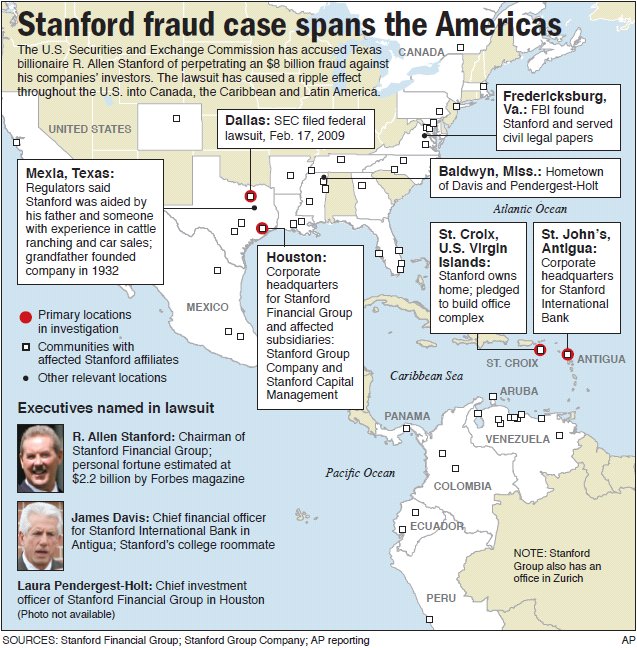
After Stanford went on the lam he was found in Fredericksburg, Virginia, just over the hill from "The Farm," the training facility of one of the U.S. Government's most famous three-letter agencies at the Marine Corps Base in Quantico.

White kid gloves only, please

The kid-glove treatment accorded two of Stanford's accomplices is another clue to Stanford's provenance. Without their help, say observers, Stanford's operation would have been shut down as much as a decade earlier.

Both were high-level U.S. Federal Agency employees, one in the DEA, the other in the SEC, America's Securities Exchange Commission, charged with preventing financial fraud.

Stanford Drug Lord

Neither Agency has exactly covered itself in glory in living memory. In the $3 trillion financial heist in 2008, the SEC, unfortunately, got there a little late...

And in the now 40-year old War on Drugs, the DEA cannot be said to be "shock and awe-ing" the global drug trade into anything like submission.

In the aftermath of Stanford's arrest, the two former high-level Federal employees fared pretty well. One, deeply and criminally implicated by numerous sources, paid just a $50,000 fine, and never even faced criminal charges.

And when the second one did face criminal charges, a miracle occurred.
Thomas Raffanello
The 'Immaculate Acquittal'


It's morning in Miami. Tuesday the 10th of February, 2010. Inside the Federal Courthouse downtown something extremely rare is about to take place: a miracle, at least the closest thing to a miracle veteran court-watchers have seen in a long time.

It comes at the end of the trial of Thomas Raffanello, Allen Stanford's Chief of Security, and the long-time chief of the Drug Enforcement Administration's Miami office. Before joining Stanford, Raffanello led investigations against Manuel Noriega and the Medellin Cartel.
Thomas Raffanello
There has long been speculation about Stanford's connections with the world of "los narcos." But Raffanello is the one verifiable link between Allen Stanford and the global drug trade.

Raffanello, accused of illegally shredding documents at Stanford Financial Group after Stanford's arrest, was taken to a Fort Lauderdale federal courtroom in shackles, facing charges of conspiracy, obstruction of justice and destroying records.

But he had committed no crime, his lawyers said in a court filing. He was simply taking out the garbage.

On the morning of February 10, 2010, Raffanello sat in court awaiting the jury's verdict as the jury asked for clarification on one of the charges. Then, after they retired to continue their deliberations, Judge Richard Goldberg ordered the charges dismissed.

Lawyers called the ruling extremely rare, almost unprecedented. "Something smells here," said one courtroom observer afterwards.

It was the Immaculate Acquittal.

"Judges always wait for the jury to finish deliberations. If the jury finds the defendant not guilty, case closed. If they find him guilty, the judge has the power to over turn the conviction. But in that case the judge proclaims, Judgment notwithstanding the verdict."

"We witnessed a miracle," said one of Raffanello's defense attorneys, Janice Burton Sharpstein.
Barry Seal
It's a small world, after all

Sharpstein is married to Richard Sharpstein, a Miami attorney who represented one of the trigger men in the assassination of Barry Seal in Baton Rouge Louisiana in 1986.

We interviewed him while researching "Barry & the Boys." But the story he told us speaks volumes about the world of Allen Stanford.

"Why was Barry Seal murdered?" we asked.

"Seal had been irate when the IRS seized all his property," Sharstein related. "The IRS man said to Seal, ‘You owe us $30 million for the money you made drug smuggling."
Thomas Raffanello "Hey, I work for you," was Seal's reply. "We both work for the same people."

"You don't work for us," the IRS agent replied. "We're the IRS."

"Then Unglesby (Seal's attorney) watched as Seal place a call to (then-Vice President) George Bush," Sharpstein stated.

"He heard Barry say, If you don't get these assholes off my back I'm going to blow the whistle on the Contra scheme."

"What Unglesby says is, That's why he's dead.

Allen Stanford isn't dead. But he pissed somebody off bad enough to make him wish he were.

Read more: http://sivg.org/article/2012_Allen_Stanford_American_Drug_Lord.html


Visit the Stanford International Victims Group - SIVG official forum http://sivg.org/forum/

Mittwoch, 7. März 2012

Stanford verdict could boost civil claims

March 7, 2012
By Leigh Jones
The conviction of Allen Stanford on Tuesday for orchestrating a $7 billion Ponzi scheme could be bad news for two prominent law firms and an attorney facing civil lawsuits arising out of the Texas financier's crimes.

Attorney Thomas Sjoblom and New York-based law firms Chadbourne & Parke and Proskauer Rose are defendants in several class actions and other lawsuits brought by Stanford Financial investors, who claim they lost hundreds of millions of dollars as a result of the fraud.

Filed mostly in Texas, the lawsuits allege that Sjoblom, who worked at Chadbourne & Parke from 2002 to 2006 and at Proskauer Rose from 2006 to 2009, helped Stanford cover up the Ponzi scheme and evade authorities. Investors claim that the firms failed to properly supervise Sjoblom and were negligent in hiring him.

Sjoblom and the law firms also are defendants in a $1.8 billion lawsuit filed in January in Washington, D.C., federal court by the receiver for Stanford Financial, who alleges claims similar to those filed by the investors.

Legal experts said that Tuesday's jury verdict against Stanford on 13 counts of fraud could bolster the class actions and individual cases against the firms and Sjoblom.

"We now know there were bad actors and people suffered. The only question left is who should pay for it," said Michael Downey, a legal malpractice attorney with law firm Armstrong Teasdale who is not involved in the Stanford matter. "The issue will be 'should we make these poor innocent investors bear the losses or the lawyers who helped make it all happen.'"

Daniel Richman, an evidence professor at Columbia Law School, said the criminal conviction does not guarantee a win in the civil actions. But the verdict could mean that information favorable to the civil cases about the scheme will "shake out," he said.

"It may well reveal the nature of any co-conspirators," he said.

Sjoblom did not respond to messages seeking comment. Prior to private practice, he was an attorney with the U.S. Securities and Exchange Commission's enforcement division. He is now a solo practitioner in Washington.

Proskauer Rose, which has about 650 attorneys, did not respond to a request for comment. Chadbourne & Parke, which has about 440 lawyers, declined to comment.

BETTER POSITION

Stanford was accused of defrauding about 30,000 investors for more than 20 years in 113 countries with high-interest certificates of deposit at Stanford National Bank, based in Antigua. He denied the allegations, but the jury on Tuesday convicted him of fraud, conspiracy and obstructing an investigation by the SEC. He was found not guilty on one count of wire fraud. He could face up to nearly 20 years in prison.

Edward Valdespino, an attorney representing some of the investors suing the law firms and Sjoblom, said that the conviction likely will give him better access to employees at the firm who were questioned by prosecutors in the criminal case but who were unable or unwilling to talk to him.

"It puts us in a better position," Valdespino said.

And Jesse Castillo, a lawyer representing about 350 plaintiffs in class actions against Sjoblom and the firms, said the criminal conviction "reinforces" his cases.

"It's satisfying to our clients," he said.

Read more: http://sivg.org/article/2012_Stanford_verdict_could_boost_civil_claims.html


Visit the Stanford International Victims Group - SIVG official forum http://sivg.org/forum/

Dienstag, 10. Januar 2012

SEC Said to Prepare Vote on Cases Against Ex-Stanford Execs

January 10, 2012
By Joshua Gallu
U.S. Securities and Exchange Commission investigators have proposed sanctions against at least five former Stanford Financial Group Co. executives and brokers for their roles in selling investments that fueled R. Allen Stanford's alleged $7 billion Ponzi scheme, according to two people with knowledge of the matter.

The SEC's five commissioners are scheduled to vote Jan. 12 on whether to authorize the enforcement actions, which target brokers and senior executives at Stanford's Houston-based brokerage, the people said, speaking on condition of anonymity because the matter isn't public. The vote by the commissioners could still be delayed or tabled, the people said.

The actions, which seek to bar the executives and brokers from working in the industry and claw back sales commissions, come almost three years after the SEC sued Stanford and a federal grand jury indicted him on 21 criminal counts alleging he used his U.S. brokerage to sell bogus certificates of deposits for his Antigua-based bank.

The SEC lawyers claim the employees ignored red flags signaling that they were selling fraudulent products, such as above-market returns promised on the CDs and outsized commissions to the brokers who sold them, one of the people said.

The investigators are treating the cases as a legal test of whether they can sanction brokers for failing to conduct due diligence on in-house products, the people said. If successful, the cases could be replicated against more ex-Stanford brokers over time, said the person.

Former NASD Official

One of the former Stanford employees whose actions were reviewed by investigators was Bernerd Young, the former regulator who later became Stanford's chief compliance officer. Young received a notice in June 2010 from SEC investigators that they planned to recommend an enforcement action against him for his role in the Stanford matter, according to his broker records.

Young became the top compliance official at Stanford's brokerage in 2006 after having worked for nearly two decades at the National Association of Securities Dealers, which later became the Financial Industry Regulatory Authority, the brokerage industry's self-regulator. He headed the NASD's Dallas office from 1999 to 2003, Finra said in a 2009 report. Young now works at Magnolia, Texas-based MGL Consulting LLC.

"Aggressive Defense"

"If the Commission authorizes the Staff to bring a formal action against Bernie, it will be met with a fierce and aggressive defense," Melinda G. LeGaye, founder and president of MGL Consulting, said in a statement today. The SEC staff "has repeatedly changed its focus in an attempt to secure Commission authorization to bring a formal action against him."

Young "has continued to cooperate and provide documentation and detailed explanations to not only refute the Staff's allegations but also to assist in their understanding of events while Bernie was at Stanford Financial Group," LeGaye said.

Randle Henderson, an attorney for Young, said in a phone interview that he didn't know whether the SEC was considering sanctions against Young. He said he has submitted multiple briefs to the SEC in defense of his client.

Trial Date

Stanford, 61, has denied the fraud allegations and last month requested that his Jan. 23 trial date be delayed by three months after his expert witnesses quit because they weren't being paid. He is being held without bail. Stanford's former accountants and heads of finance and investment also face criminal and civil claims.

The SEC has been reviewing the case for more than two years as Stanford customers and lawmakers criticized investigators for not catching the alleged scheme sooner. The SEC's inspector general said the agency didn't conduct a meaningful probe of Stanford's business until 2005, even though examiners suspected fraud eight years earlier.

Read more: http://sivg.org/article/2012_SEC_Against_Stanford_Execs.html


Visit the Stanford International Victims Group - SIVG official forum http://sivg.org/forum/

Mittwoch, 21. Dezember 2011

KLS complaint against the U.S. Government/SEC

December 21, 2011
By Dr. Gaytri D. Kachroo
Ft. Lauderdale, FLA - A class action lawsuit was filed against the United States on December 13, 2011, for the billions in losses suffered by investors in the Allen Stanford international Ponzi scheme.

The case, filed in the United States District Court for the Southern District of Florida seeks to hold the SEC responsible for its failure to stop Stanford and his registered investment advisor and broker/dealer company Stanford Group Company ("SGC"), who the SEC investigated several times between 1997 and 2004. The suit claims that the SEC was grossly negligent in its actions following each investigation in failing to take any action to stop Stanford, whom SEC official had determined was operating a Ponzi scheme. The class action against the SEC was filed the day after the SEC filed suit against the Securities Investor Protection Corporation ("SIPC") for its refusal to reimburse investors for their losses.

"This case is unique because the SEC knew all along that this was a fraud and did nothing," said lead attorney Dr. Gaytri Kachroo of Kachroo Legal Services, P.C. (KLS), who is representing investors in the class action. "If the SEC had simply refused to register SGC for any of its various securities laws violations or reported to SIPC that SBC was a Ponzi scheme and insolvent, the SEC could have stopped this scheme over a decade ago."

In government investigations in 1997, 1998, 2002, and 2004, the SEC determined that Stanford was operating a Ponzi Scheme, but failed to take action to prevent his fraud. After increasing pressure from the Madoff collapse, the SEC finally acted in 2009, filing a case in federal court against Stanford and his companies, but only after investors had been defrauded of over $7 billion. The suit also alleges that the court-appointed SEC receiver has only been able to recover $100 million, net of expenses, out of the $7 billion investors lost because of the SEC's negligence.

The case is Zelaya et al. v. United States of America, Case No. 11-CV-62644-RNS (S. D. Fla. 2011).

Source: http://sivg.org/article/KLS_complaint_against_SEC.html


Visit the Stanford International Victims Group - SIVG official forum http://sivg.org/forum/

Dienstag, 13. Dezember 2011

Madoff's case bigger, but Stanford's messier

Madoff vs Stanford December 13, 2011
By Loren Steffy

From the beginning, the collapse of R. Allen Stanford's financial empire was unlike other financial scandals, and the aftermath of his alleged $7 billion
Bernard Madoff vs Allen Stanford.
fraud has been messier than normal for investors in such cases.

Bernard Madoff, after all, orchestrated a Ponzi scheme almost 10 times bigger than the one Stanford is accused of running, yet Madoff pleaded guilty and is serving a lifetime prison sentence.

A receiver (Irving Picard) has recovered billions that is being distributed to investors, and an insurance pool funded by the brokerage industry is covering at least some of the additional losses.

Not so in the Stanford case. Investors are likely to recover almost nothing from the receiver Ralph Janvey, and on Monday, the Securities and Exchange Commission sued the industry insurance fund, the Securities Investor Protection Corp., which since June has refused the SEC's order to pay.

Stanford Financial was an SIPC member, and it slapped the fund's logo on its investment offerings. While the SIPC doesn't provide blanket insurance - it only protects against securities that are lost or stolen in brokerage failures, not losses on the value of investments - it was happy to allow Stanford to use its name to foster a false aura of security.

It now argues that those same investors don't deserve coverage because Stanford brokers were peddling certificates of deposits issued by Stanford's Caribbean bank.

But investors I've spoken with said their money went through, and perhaps never left, Stanford's brokerage with the SIPC seal on the door.

The distinction between the Stanford and Madoff cases is most stark in how investors have been treated by the organizations that are supposed to protect them.

Madoff was, after all, a Wall Street insider who catered to other well-connected financiers and movie stars. The SIPC agreed to cover their losses. Kevin Bacon, it seems, will have a lesser degree of separation from his wealth than the average Stanford investor. Similarly, when MF Global, a commodities trader run by the former U.S. senator and Goldman Sachs honcho Jon Corzine, tanked on bad investments in European markets, the SIPC rushed in to repay some of the losses for the firm's wealthy hedge fund clients.

Stanford's investors for the most part are more pedestrian. They were well-off but not wealthy. Most invested for retirement, and while much was made of the ridiculous interest rates promised on Stanford CDs, investors said what attracted them most was the safety. They were looking for a shelter from turbulent markets, and CDs, Stanford brokers told them, were a safe move.

Many didn't go to Stanford, Stanford came to them. The firm built its brokerage by recruiting investment advisers from other firms who brought clients with them. Seduced by the green marble desktops and cherry-wood interiors, they knowingly or not lured into Stanford's web clients with whom they'd built up trust over many years.

Stanford's investors also were hurt by bad timing. Their plight came just months after Madoff dominated the national news, and it was overshadowed by a mounting recession, looming bank failures and government bailouts.

And so, amid national disinterest and regulatory foot-dragging, Stanford investors have become the alleged victims of a forgotten fraud. It's not surprising, then, that their fate depends on the unprecedented legal action by the SEC against the SIPC.

For three years, they've had to fight just for a chance to grab the safety net that was thrown to investors in other scandals.


Visit the Stanford International Victims Group - SIVG official forum http://sivg.org/forum/

Montag, 12. Dezember 2011

SEC sues insurance fund in Stanford case

December 12, 2011
By Loren Steffy
The Securities and Exchange Commission, in an unprecedented move, sued a national brokerage insurance fund to force it to cover potential investor losses from R. Allen Stanford's alleged $7.2 billion Ponzi scheme.

The lawsuit, filed in federal court in Washington, would require the Securities Investor Protection Corp., or SIPC, to begin a liquidation proceeding for Stanford's U.S. brokerage, which was based in Houston. The liquidation would let customers file claims under federal investor protection laws.

The court action comes after months of negotiations between the SEC and SIPC failed to produce an agreement. SIPC, which is funded by the brokerage industry, has resisted covering losses in the 2009 collapse of Stanford Financial Group, saying the investments were certificates of deposit with an offshore bank rather than securities.

"It's time to get even tougher in our fight for the victims," said Sen. David Vitter, R-La., who led the fight in Congress on behalf of Stanford investors. "I've been urging SIPC Chairman Johnson to act quickly for months, but the victims still haven't received an up-or-down answer. This move by the SEC is encouraging and should significantly help the process."

Last week, Vitter pressed SEC Chairman Mary Schapiro to sue.

The SEC, which has oversight authority for SIPC, argued that the CDs constituted securities and were sold to investors through Stanford's SIPC-insured brokerage.

In June, the commission ordered SIPC to cover investor losses, much as it has for those who lost money in Bernard Madoff's Ponzi scheme, but SIPC's board didn't respond to the order.

"Because SIPC has declined to take steps to initiate the proceeding for the protection of Stanford customers, the commission filed suit today asking a court to compel it to do so," the SEC said in a statement.

Why it's fighting back

SIPC officials said they intend to fight the suit.

"After careful and exacting analysis, we believe the SEC's theory in this case conflicts with the Securities Investor Protection Act, the law that created SIPC and has guided it for the last 40 years," fund chairman Orlan Johnson said in a prepared statement.

Stanford's membership in SIPC reassured investors like Carl Rabenaldt, who works for a Houston engineering firm. He invested his retirement in the CDs in part because he thought his money was covered by SIPC. "Then, when there's a claim against it, they're finding reasons not to pay it," he said.

R. Allen Stanford is accused of defrauding thousands of investors by selling them certificates of deposit from his bank in Antigua, assuring them that the investments were safe.

He then allegedly used the money for other purposes, including funding a lavish lifestyle for himself and investing it in highly speculative private businesses.

Settlement offered?

SIPC last week offered to cover a portion of the Stanford investors' losses, but the SEC found the offer unacceptable, according to a person familiar with the discussions.

At a closed-door meeting Wednesday, the commission decided to proceed with the suit, the person said, adding that SIPC may still make another settlement offer.

SIPC, created in 1970, is designed to insure investors if a brokerage fails and cash or securities are missing from customer accounts. It isn't designed to cover losses from declines in investments' value.

SIPC officials had argued that the Stanford case is different than Madoff's. Stanford investors sent money to buy CDs directly to Stanford's Antiguan bank and therefore they weren't "customers" of the brokerage under the definition of the law, they said. In addition, they argued that Stanford's CDs, while worthless, did exist, and therefore insurance coverage isn't warranted.

The SEC contends the money investors thought was being used to buy the CDs was diverted for other purposes and the CDs were never actually purchased. Because the CDs were sold through the SIPC-insured brokerage, the insurance pool should cover the losses, it argued.

The coverage would apply to about 7,800 of Stanford's 20,000 investors worldwide.
ANALYSIS OF SECURITIES INVESTOR PROTECTION ACT COVERAGE FOR STANFORD GROUP COMPANY
The SEC has authorized its Division of Enforcement to bring an action in district court against SIPC to compel the institution of a proceeding to liquidate SGC under SIPA.

The Commission has determined that the statutory requirements for instituting a SIPA liquidation are met here. SGC is insolvent and the subject of a receivership. And for the reasons discussed below, the Commission has concluded that SGC has failed to meet its obligations to customers. Based on the totality of the facts and circumstances of this case, the Commission has determined (in an exercise of its discretion) that SIPC should initiate a proceeding under SIPA to liquidate SGC.

In concluding that investors who purchased the SIBL CDs through SGC qualify for protected "customer" status, the Commission finds two lines of cases applying SIPA particularly relevant. First, courts have held that, under certain circumstances, an investor may be deemed to have deposited cash with a brokerdealer for the purpose of purchasing securities-and thus be a "customer" under Section 16(2) of SIPA - even if the investor initially deposited those funds with an entity other than the broker-dealer. Second, courts have held that when securities purportedly acquired for customers by a broker-dealer are actually fraudulent vehicles for carrying out a Ponzi scheme, customers' "net equity" claims under SIPA can be measured by the net amount of cash customers invested and not by the purported but unreal value of the fraudulent securities (including fictitious "profits").

In In re Old Naples, the Eleventh Circuit addressed whether claimants who had deposited cash with an affiliate of a broker-dealer in order to purchase securities could nonetheless qualify as customers of the failed broker-dealer. The court held that the investors should be deemed to have deposited cash with the broker-dealer based on evidence supporting the bankruptcy court's findings that (1) the investors "had no reason to know that they were not dealing with" the broker-dealer; and (2) the funds investors deposited with the affiliate "were used by, or at least for," the broker-dealer, who "diverted some of the investors' money from [the affiliate] for personal use, and... used much of the money to pay [the broker-dealer's] expenses."

The totality of facts and circumstances in this case supports a similar conclusion about the status of the investors with accounts at SGC who purchased SIBL CDs, i.e., that by depositing money with SIBL, investors were effectively depositing money with SGC. Based on the findings of the Receiver and his expert investigators, the separate existence of SIBL, SGC, STC, and their ultimate, sole owner, Stanford should be disregarded.

In so doing, the court focused on the substance of the transactions rather than their form.

Credible evidence shows that Stanford structured the various entities in his financial empire, including SGC and SIBL, for the principal, if not sole, purpose of carrying out a single fraudulent Ponzi scheme. These many entities (controlled and directly or indirectly owned by Stanford) were operated in a highly interconnected fashion, with a core objective of selling fraudulent SIBL CDs.

Additionally, as in Old Naples, there are facts that could have led SGC account holders who purchased SIBL CDs through SGC to believe they were depositing cash with SGC for the purpose of purchasing the CDs. Defrauded CD investors have submitted affidavits stating that they were told by their SGC financial advisors that SGC and SIBL were both members of the "Stanford Financial Group," and that Stanford financial advisers frequently referred simply to "Stanford" without clearly distinguishing between SGC and SIBL. Affidavit of Sally Matthews

Both SGC and SIBL had the word "Stanford" in their names and used the same logo, and SGC provided at least some customers with "advisory statements" bearing that logo that listed their SIBL CD positions.

There is also credible evidence that, as in Old Naples, the funds deposited with SIBL were diverted for Stanford's personal use and used to pay the expenses of SGC.

In an August 14, 2009 letter to the Receiver, SIPC President Stephen P. Harbeck stated that "if SGC and SIBL are consolidated ... the CDs are, in effect, debts of SGC, and are part of the capital of SGC. Such a relationship negates 'customer' status under 15 U.S.C. § 78lll(2)(B) [as amended, § 78lll(2)(C)(ii)]." The Commission disagrees for the reasons the courts in C.J. Wright, Old Naples, and Primeline rejected similar arguments advanced by the SIPA Trustee as grounds for denying customer status. In C.J. Wright, the court found that claimants "believed they were depositing funds for the purchase of securities and were not told and were not aware that their investment was to become part of debtor's capital."
SECURITIES AND EXCHANGE COMMISSION'S MEMORANDUM OF POINTS AND AUTHORITIES IN SUPPORT OF APPLICATION.


Visit the Stanford International Victims Group - SIVG official forum http://sivg.org/forum/

Montag, 5. Dezember 2011

US-Committee in opposition to Grant Thornton

December 5, 2011
By the US-Committee
The Official Stanford Investors Committee (the "Investors Committee") submits this brief in opposition to the Petition for Recognition of Foreign Main Proceeding Pursuant to Chapter 15 of Bankruptcy Code (the "Petition"). The Petition was originally filed by former liquidators, Nigel Hamilton-Smith and Peter Wastell, and is now championed by Marcus Wide and Hugh Dickson (the "Joint Liquidators").

The Investors Committee respectfully urges the Court to deny the Joint Liquidators any form of recognition under Chapter 15. Any recognition of these Joint Liquidators would be "manifestly contrary to the public policy of the United States". That is so for at least four separate reasons.

First, the appointment of the Joint Liquidators (and their predecessors) was pursued and obtained in violation of this Court's Orders. Granting these Joint Liquidators any form of Chapter 15 recognition, under these circumstances, would undermine fundamental regulatory and jurisdictional policies of the United States.

Second, there are significant conflicts of interest raised by the Joint Liquidators's request for recognition as the "foreign main" proceeding. The Receivership Estate has significant claims against the Antiguan government that will likely be frustrated (or abandoned) if the Joint Liquidators achieve "foreign main" recognition. The Investors Committee believes those conflicts are exacerbated by the multiple representations that have been undertaken in this proceeding by counsel for the Joint Liquidators.

Third, the recognition sought by the Joint Liquidators should be denied because it is very much a "one-way street." The Antiguan courts have already refused to recognize this Court's Receiver, finding both that the Receiver has "no legal entitlement to standing in Antigua and Barbuda" and that this Court's Order appointing the Receiver and taking sole possession of the assets of the various Stanford entities, including SIBL, was "unenforceable."

Fourth, recognition should be denied because it has become painfully obvious that the Antiguan government and the Antiguan judicial system have no real interest in prosecuting the individuals responsible for the Stanford fraud, nor in recovering assets for the benefit of Stanford's investor-victims.


Visit the Stanford International Victims Group - SIVG official forum http://sivg.org/forum/