April 18, 2012
By ACFCS Staff
By ACFCS Staff
The case in which TD Bank has already lost a precedent-setting verdict for "aiding and abetting fraud" arising
from collusion with one of its customers to defraud numerous persons and to launder the proceeds has taken an
ugly turn.
A 70-day trial that ended in January produced a $67 million victory for Coquina Investments in its civil suit against TD Bank. Coquina was a victim of a megafraud perpetrated by TD Bank customer, Scott Rothstein, a convicted former lawyer now serving a 50-year prison term. The bank has appealed the verdict.
But now, TD Bank, one of the world's largest banks, confronts explosive post-trial charges that it produced a fraudulent piece of evidence at the trial that falsely hid its internal assessment that Rothstein and his firm were a "high risk" for money laundering.
The evidence, a 2009 TD Bank document called a "Customer Due Diligence" form, contained the findings of the pre-account opening inquiry by the bank of Rothstein's firm, Rothstein, Rosenfeldt and Adler.
Coquina Investments, the fraud victim that won the unprecedented verdict, alleged on March 26 that the bank perpetrated a "fraud on the court and jury" by hiding a red banner that contained the all-upper-case words "HIGH RISK."
The accusation, in the form of a motion for sanctions filed by Coquina's lead lawyer, David Mandel, of the Miami firm, Mandel & Mandel, alleges that TD Bank and its lawyers at Greenberg Traurig intentionally altered the form to keep the jury from seeing the official designation of Rothstein's law firm as "high risk."
TD Bank says altered form did not hurt plaintiff's case
TD responded to the accusation on April 12, denying any intention to mislead the jury. It said the alteration of the form resulted from a "copying error" by clerical staff and that Mandel knew of the high risk designation and stressed that to the jury in his closing argument. The bank said the altered form did not significantly influence the jury or change the trial's outcome, which was favorable to Coquina in any event.
Mandel countered with a strongly-worded reply on April 16, saying the bank's "response is tantamount to a continuing fraud on the court." He said TD Bank's explanation that its "copying process" was to blame for the doctored document "is not credible and can't be replicated."
He said "the trial would have proceeded much differently had the defendant produced the true document." Coquina's $67 million verdict included $35 million in punitive damages. Mandel had asked the jury to award $140 million in punitive damages.
With true form in hand, jury may have awarded higher damages
"Coquina is unfairly left to wonder what the jury's punitive damages award might have been if [TD Bank] had produced an unaltered version of the document before trial," says Mandel.
"The integrity of our judicial system demands that [TD Bank's] actions have consequences," he added.
Mandel said the bank not only introduced "the altered document into evidence," but also "affirmatively used it, both to cross-examine Coquina's expert and in closing argument." The bank, he says, "insisted that (Rothstein's firm) was a Low Risk customer" and berated Coquina's expert for asserting otherwise.
He alluded to a federal law at Title 18 USC, Section 1512(c)(1), which makes it a criminal offense to intentionally alter a document for use in a trial.
"Unreasonable" to believe alteration was accidental, Mandel says
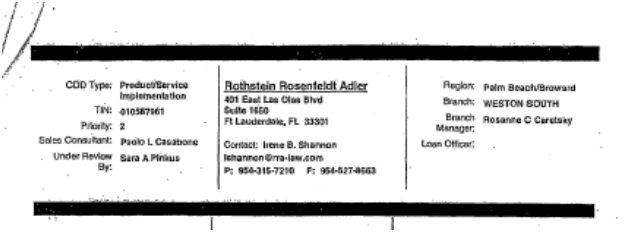
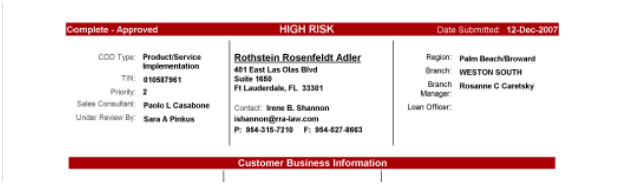
The version of the Customer Due Diligence form the bank introduced in evidence had a simple black bar as a heading. Mandel says the true form, which he obtained in another case in which TD Bank is being sued, contains the words "HIGH RISK" emblazoned across the top, highlighted by a red background.
He says the alteration was so obvious and egregious that it had to be deliberate and that the misleading form propped up TD's defense that it knew nothing of Rothstein's fraud, did not help him perpetrate it and viewed his law firm as low risk.
"With tens of millions of dollars on the line, the Defendant asks the Court to believe... that it accidentally altered the document and presented it to the jury in a fashion that was undeniably misleading," says Mandel. He calls the argument "nonsense."
TD Bank denies bad faith
The bank's April 12 response denies it acted in "bad faith" and says changes to the form were unintentional by unnamed administrative staff.
The bank submitted a signed declaration by Sara Pinkus, a risk officer who had been asked to "gather customer due diligence records" to send to Greenberg Traurig for the trial. Pinkus says she printed the form and turned it over to an assistant for photocopying. The form was sent to the law firm, where a clerical assistant scanned the form and converted it to electronic format.
The bank says "the printing and copying process inadvertently blackened all of the words in all of the colored headers of the [form]," including the "HIGH RISK" designation.
Mandel calls this explanation "insufficient, inaccurate and potentially perjurious."
"Coquina attempted to replicate the Defendant's "copying process," but none of our efforts resulted in the words HIGH RISK being obscured from the document." he adds.
TD Bank declined requests for comment by ACFCS.org, citing its policy of not commenting on "pending litigation."
TD Bank says it "sincerely regrets this copying error," but contends that the obliterated "HIGH RISK" heading had no impact on Coquina's presentation at trial.
TD Bank's laundering expert testified Rothstein's firm was not "high risk"
TD Bank's response is silent on why Ivan Garces, who was TD Bank's anti-money laundering trial expert, testified that Rothstein was not a high-risk customer when its Customer Due Diligence form labeled him as such. Garces' had this colloquy at trial with a lawyer in Mandel's firm:
Coquina lawyer: Now is it - it's your opinion, sir, that TD Bank did not consider RRA [Rothstein's law firm] to be a high-risk customer of the bank; is that right?
Garces: Yes, ma'am. That's correct.
Coquina lawyer: It's not a high-risk customer.
Garces: It did not consider it a high-risk customer.
Mandel says in his new reply that "if the true document had been produced and entered into evidence..., it is hard to imagine anyone brazen enough to claim that [TD Bank] did not consider [Rothstein's law firm] to be a HIGH RISK customer."
Call for sanctions includes referral to Justice Department, Florida Bar
Mandel has requested that US District Court Judge Marcia G. Cooke impose a series of sanctions, including referring TD Bank to the US Department of Justice for criminal investigation and referral of Greenberg Traurig to the Florida Bar for review of possible ethical violations.
Judge Cooke, who presided over the long trial, has not yet acted on the motion, which requests sanctions.
The case offers many anti-money laundering and fraud control lessons to financial institutions. The experience of TD Bank also plants the seeds of headaches for financial institutions whose employee compensation plans include bonuses for attracting "assets under management."
(The two versions of the top part of TD Bank's Customer Due Diligence Form for Rothstein's defunct law firm, Rothstein, Rosenfeldt and Adler, follow. The version presented in the Coquina case appears first, followed by the unaltered version.)


A 70-day trial that ended in January produced a $67 million victory for Coquina Investments in its civil suit against TD Bank. Coquina was a victim of a megafraud perpetrated by TD Bank customer, Scott Rothstein, a convicted former lawyer now serving a 50-year prison term. The bank has appealed the verdict.
But now, TD Bank, one of the world's largest banks, confronts explosive post-trial charges that it produced a fraudulent piece of evidence at the trial that falsely hid its internal assessment that Rothstein and his firm were a "high risk" for money laundering.
The evidence, a 2009 TD Bank document called a "Customer Due Diligence" form, contained the findings of the pre-account opening inquiry by the bank of Rothstein's firm, Rothstein, Rosenfeldt and Adler.
Coquina Investments, the fraud victim that won the unprecedented verdict, alleged on March 26 that the bank perpetrated a "fraud on the court and jury" by hiding a red banner that contained the all-upper-case words "HIGH RISK."
The accusation, in the form of a motion for sanctions filed by Coquina's lead lawyer, David Mandel, of the Miami firm, Mandel & Mandel, alleges that TD Bank and its lawyers at Greenberg Traurig intentionally altered the form to keep the jury from seeing the official designation of Rothstein's law firm as "high risk."
TD Bank says altered form did not hurt plaintiff's case
TD responded to the accusation on April 12, denying any intention to mislead the jury. It said the alteration of the form resulted from a "copying error" by clerical staff and that Mandel knew of the high risk designation and stressed that to the jury in his closing argument. The bank said the altered form did not significantly influence the jury or change the trial's outcome, which was favorable to Coquina in any event.
Mandel countered with a strongly-worded reply on April 16, saying the bank's "response is tantamount to a continuing fraud on the court." He said TD Bank's explanation that its "copying process" was to blame for the doctored document "is not credible and can't be replicated."
He said "the trial would have proceeded much differently had the defendant produced the true document." Coquina's $67 million verdict included $35 million in punitive damages. Mandel had asked the jury to award $140 million in punitive damages.
With true form in hand, jury may have awarded higher damages
"Coquina is unfairly left to wonder what the jury's punitive damages award might have been if [TD Bank] had produced an unaltered version of the document before trial," says Mandel.
"The integrity of our judicial system demands that [TD Bank's] actions have consequences," he added.
Mandel said the bank not only introduced "the altered document into evidence," but also "affirmatively used it, both to cross-examine Coquina's expert and in closing argument." The bank, he says, "insisted that (Rothstein's firm) was a Low Risk customer" and berated Coquina's expert for asserting otherwise.
He alluded to a federal law at Title 18 USC, Section 1512(c)(1), which makes it a criminal offense to intentionally alter a document for use in a trial.
"Unreasonable" to believe alteration was accidental, Mandel says
The version of the Customer Due Diligence form the bank introduced in evidence had a simple black bar as a heading. Mandel says the true form, which he obtained in another case in which TD Bank is being sued, contains the words "HIGH RISK" emblazoned across the top, highlighted by a red background.
He says the alteration was so obvious and egregious that it had to be deliberate and that the misleading form propped up TD's defense that it knew nothing of Rothstein's fraud, did not help him perpetrate it and viewed his law firm as low risk.
"With tens of millions of dollars on the line, the Defendant asks the Court to believe... that it accidentally altered the document and presented it to the jury in a fashion that was undeniably misleading," says Mandel. He calls the argument "nonsense."
TD Bank denies bad faith
The bank's April 12 response denies it acted in "bad faith" and says changes to the form were unintentional by unnamed administrative staff.
The bank submitted a signed declaration by Sara Pinkus, a risk officer who had been asked to "gather customer due diligence records" to send to Greenberg Traurig for the trial. Pinkus says she printed the form and turned it over to an assistant for photocopying. The form was sent to the law firm, where a clerical assistant scanned the form and converted it to electronic format.
The bank says "the printing and copying process inadvertently blackened all of the words in all of the colored headers of the [form]," including the "HIGH RISK" designation.
Mandel calls this explanation "insufficient, inaccurate and potentially perjurious."
"Coquina attempted to replicate the Defendant's "copying process," but none of our efforts resulted in the words HIGH RISK being obscured from the document." he adds.
TD Bank declined requests for comment by ACFCS.org, citing its policy of not commenting on "pending litigation."
TD Bank says it "sincerely regrets this copying error," but contends that the obliterated "HIGH RISK" heading had no impact on Coquina's presentation at trial.
TD Bank's laundering expert testified Rothstein's firm was not "high risk"
TD Bank's response is silent on why Ivan Garces, who was TD Bank's anti-money laundering trial expert, testified that Rothstein was not a high-risk customer when its Customer Due Diligence form labeled him as such. Garces' had this colloquy at trial with a lawyer in Mandel's firm:
Coquina lawyer: Now is it - it's your opinion, sir, that TD Bank did not consider RRA [Rothstein's law firm] to be a high-risk customer of the bank; is that right?
Garces: Yes, ma'am. That's correct.
Coquina lawyer: It's not a high-risk customer.
Garces: It did not consider it a high-risk customer.
Mandel says in his new reply that "if the true document had been produced and entered into evidence..., it is hard to imagine anyone brazen enough to claim that [TD Bank] did not consider [Rothstein's law firm] to be a HIGH RISK customer."
Call for sanctions includes referral to Justice Department, Florida Bar
Mandel has requested that US District Court Judge Marcia G. Cooke impose a series of sanctions, including referring TD Bank to the US Department of Justice for criminal investigation and referral of Greenberg Traurig to the Florida Bar for review of possible ethical violations.
Judge Cooke, who presided over the long trial, has not yet acted on the motion, which requests sanctions.
The case offers many anti-money laundering and fraud control lessons to financial institutions. The experience of TD Bank also plants the seeds of headaches for financial institutions whose employee compensation plans include bonuses for attracting "assets under management."
(The two versions of the top part of TD Bank's Customer Due Diligence Form for Rothstein's defunct law firm, Rothstein, Rosenfeldt and Adler, follow. The version presented in the Coquina case appears first, followed by the unaltered version.)
Related article:
TD Bank, lawyers accused of "fraud on court" for presenting false "Customer Due Diligence Form".
TD Bank, lawyers accused of "fraud on court" for presenting false "Customer Due Diligence Form".
Read more: http://sivg.org/article/2012_TD_Bank_says_copying_error.html
Visit the Stanford International Victims Group - SIVG official forum http://sivg.org/forum/

