Mittwoch, 22. August 2012

SEC MOTION TO INTERVENE AND TO SUSPEND THE MEMORANDUM OPINION AND ORDER OF JULY 3, 2012

August 22, 2012
By Matthew T. Martens
Applicant U.S. Securities and Exchange Commission ("SEC" or "Commission") respectfully submits this memorandum of law in response to Robert Cheatham's Motion To Intervene and To Suspend the Memorandum Opinion and Order of July 3, 2012 ("Motion To Intervene").

Mr. Cheatham contends that he may intervene as of right in this proceeding pursuant to Federal Rule of Civil Procedure 24(a)(2). That provision states that intervention must be granted as of right, "[o]n timely motion," to anyone who "claims an interest relating to the property or transaction that is the subject of the action, and is so situated that disposing of the action may as a practical matter impair or impede the movant's ability to protect its interest, unless existing parties adequately represent that interest." In other words, the right of a party to intervene depends on the following four factors:

(1) the timeliness of the motion; (2) whether the applicant "claims an interest relating to the property or transaction which is the subject of the action"; (3) whether "the applicant is so situated that the disposition of the action may as a practical matter impair or impede the applicant's ability to protect that interest"; and (4) whether "the applicant's interest is adequately represented by existing parties.".

More Info: http://sivg.org/article/2012_SEC_Brief_in_Opposition_of_Motion_to_Intervene.html


Visit the Stanford International Victims Group - SIVG official forum http://sivg.org/forum/

Mittwoch, 8. August 2012

Complaint against PROSKAUER ROSE, LLP, CHADBOURNE & PARKE, LLP, and THOMAS V. SJOBLOM

August 8, 2012
By ATTORNEYS FOR THE OSIC
Ralph S. Janvey, in his capacity as the Court-Appointed Receiver for the Stanford Receivership Estate, and the Official Stanford Investors Committee file this First Amended Complaint (the "Complaint") against Defendants PROSKAUER ROSE, LLP, CHADBOURNE & PARKE, LLP, and THOMAS V. SJOBLOM (collectively, the "Defendants").

Defendant Proskauer Rose, LLP ("Proskauer") is a limited liability partnership organized under the laws of the State of New York. Defendant Proskauer has already appeared in this action.

Defendant Chadbourne & Parke, LLP ("Chadbourne") is a limited liability partnership organized under the laws of the State of New York. Defendant Chadbourne has already appeared in this action.

Together, Defendants Proskauer and Chadbourne are collectively referred to as the "Law Firm Defendants".

Defendant Thomas V. Sjoblom ("Sjoblom") is an individual who currently resides in the State of Virginia. Defendant Sjoblom has already appeared in this action.

Defendants Proskauer and Chadbourne are liable for the tortious acts of their employee, Defendant Sjoblom. From the time that Sjoblom joined the conspiracy described herein in June 2005 until sometime in August 2006, Sjoblom was employed by Chadbourne. Thereafter, from August 2006 through late 2009, Sjoblom was an employee of Proskauer. Sjoblom was acting within the course and scope of his respective employments with Proskauer and Chadbourne, and in furtherance of said law firms' respective businesses, when he engaged in the wrongful conduct described herein.

The Stanford Financial companies, and therefore the Receiver and/or the Committee, have suffered the loss of billions of dollars in assets that were proximately caused by the wrongful conduct of Defendants and their conspiracy with Allen Stanford and others as described herein. In the alternative, Defendants Chadbourne, Proskauer and Sjoblom are liable for all damages caused to Stanford Financial, and therefore to the Receiver and/or the Committee, during the time period from 2005 to 2009 when the Defendants participated in the conspiracy to obstruct the SEC investigation of Stanford Financial's, SIBL's, and SGC's fraudulent sales practices. In addition, the Receiver and/or the Committee are entitled to recover their just and reasonable attorneys' fees, subject to Court approval, for it would be inequitable not to award such fees to them. The Receiver and/or the Committee have retained the undersigned attorneys and have agreed to pay them a reasonable attorneys' fee for their work.

The Receiver and the Committee request that the Defendants be summoned to answer this Complaint, that the case be tried before a jury, and that upon final judgment the Receiver and the Committee recover their damages as alleged herein, including their actual damages, punitive damages, and their costs and expenses of suit, including reasonable attorneys' fees. The Receiver and the Committee pray for such other relief to which they may be justly entitled.

More Info: http://sivg.org/article/2012_Lawsuit_PROSKAUER_ROSE_CHADBOURNE_and_THOMAS_SJOBLOM.html


Visit the Stanford International Victims Group - SIVG official forum http://sivg.org/forum/

Montag, 30. Juli 2012

Order re. Chapter 15 / COMI

July 30, 2012
By U.S. District Judge David C. Godbey
The Court grants the Joint Liquidators' motion for substitution as Plaintiff nunc pro tunc to June 8, 2010 and grants in part and denies in part their request that the Court take judicial notice. The Court overrules the parties' objections to each others' evidence. Finally, because the Stanford Entities' COMI is in the United States and they have an establishment in Antigua, the Court grants the Antiguan Proceeding foreign nonmain recognition, granting in part and denying in part the Joint Liquidators' petition for recognition. The Court grants the Joint Liquidators limited, conditional relief under Chapter 15.

In accordance with this Order, the Court orders the Clerk of the Court to terminate Peter Wastell and Nigel Hamilton-Smith as Plaintiffs and add Marcus Wide and Hugh Dickson as Plaintiffs.

Read more: http://sivg.org/article/2012_Order_Chapter_15_COMI.html


Visit the Stanford International Victims Group - SIVG official forum http://sivg.org/forum/

Dienstag, 24. Juli 2012

Motion To Intervene and To Suspend the Memorandum Opinion and Order of July, 3, 2012

July 24, 2012
By Richard R. Cheatham
Pursuant to Fed. R. Civ. P. 24 Richard R. Cheatham moves to intervene in this action in order to protect his interest in the subject of the action and pursuant to Fed. R. Civ. P. 59 to suspend the Court's Memorandum Opinion and Order of July, 3, 2012 pending reconsideration in light of the facts presented in connection Intervener's Motion to Intervene.

In support of this motion, Richard R. Cheatham relies on the Court's Memorandum Opinion and Order of July, 3, 2012 and his Memorandum In Support of Motion To Intervene and To Suspend Memorandum Opinion and Order of July, 3, 2012.
SENATE and HOUSE letter to Schapiro
SIPC OPPOSITION TO MOTION TO INTERVENE
On July 24, 2012, Richard Cheatham filed a motion to intervene and to "suspend" the Court's July 3 Opinion—three weeks after the fact. Although he provides no documentary evidence in support of his assertions, Cheatham contends that brokers from the Stanford Group Company ("SGC") purchased Stanford International Bank, Ltd. ("SIBL") CDs for him without his knowledge, and that the SEC failed to consider the "atypical" nature of these CD purchases in pursuing its case. The Court should reject Cheatham's thirteenth-hour motion for three separate and independent reasons...

Read more: http://sivg.org/article/2012_Motion_To_Intervene_and_Suspend_SIPC_Opinion_Order.html


Visit the Stanford International Victims Group - SIVG official forum http://sivg.org/forum/

Dienstag, 17. Juli 2012

HSBC lapses left US economy exposed to exploitation by terrorists - Senate report

July 17, 2012
By Richard Blackden
HSBC left America's financial system exposed to exploitation by drug cartels and terrorist organisations due to its failure to comply with anti-money laundering laws, according to a damning US Senate report.

These are two of the findings in a 340-page study from the US Senate that accuses Britain's biggest bank of a series of compliance lapses between 2004 and 2010.

HSBC, the only British bank with a branch network in America, failed to properly staff its compliance department and wrongly designated Mexico as a "low-risk" country.

The findings are a major embarrassment for HSBC, some of whose senior executives will appear before the Senate committee tomorrow to explain the failings.

In one of the more damaging accusations, the report says HSBC resumed providing banking services to a Saudi Arabian bank despite speculation it had links to financing terrorism.

In an emailed statement, HSBC said the Senate report had provided "important lessons for the whole industry in seeking to prevent illicit actors entering the global financial system".

The bank said it is spending more money on compliance and has become more coordinated in policing high-risk transactions.

HSBC is also criticised by the committee for designating Mexico as "low-risk" despite the widespread use of the country's banking system by drug cartels. The decision made it easier for money to be moved between HSBC's affiliate bank in Mexico and its network in the US. Its Mexican bank should have been treated as a "high-risk correspondent client subject to enhanced due diligence and monitoring," the report said.

The report also contained strong criticism of the Office of the Comptroller of the Currency, a top US bank regulator, saying the regulator failed to crack down on the bank despite multiple red flags, allowing money laundering issues "to accumulate into a massive problem".

HSBC has warned investors that it could face a significant fine in the US, with some analysts speculating the penalty could reach $1bn.

"Accountability is essential and that is what has been missing here," said Carl Levin, the chairman of the committee on permanent investigations. HSBC said last night that it had taken several steps to improve its compliance, including doubling its spend on compliance and enforcing standards globally.

Read more: http://sivg.org/article/2012_HSBC_drug_cartels_and_terrorist_organisations.html


Visit the Stanford International Victims Group - SIVG official forum http://sivg.org/forum/

Donnerstag, 12. Juli 2012

Bill Cassidy request that SEC file an appeal

July 12, 2012
By Bill Cassidy
Dear Chairwoman Schapiro,
I write to respectfully request that the Securities & Exchange Commission (SEC) file an appeal with the U.S. Court of Appeals, District of Columbia Circuit, seeking to overturn the July 3, 2012 ruling by U.S. District Court Judge Robert L. Wilkins in the matter of SEC v. Securities Investors Protection Corporation (SIPC), Civil Action No. 11-mc-678.

As you know, this case involves the matter of restitution for the victims of the former Stanford Financial Group under the Securities Investor Protection Act (SIPA) of 1972. In July of 2011, in its capacity as the regulator of SIPC, the SEC ordered a liquidation and payment under SIPA to certain affected customers of the former Stanford companies. SIPC however, refused to comply with the SEC’s order, which led to the court proceedings and ultimately, the decision rendered by Judge Wilkins denying SIPA coverage for the Stanford victims.

In the Sixth Congressional District of Louisiana and throughout the country, financial restitution under SIPA represents the last hope for many of Stanford’s victims to regain that which was taken from them more than three years ago. All I ask on behalf of these American citizens is for the SEC to honor the commitment they made back in July of 2011 by continuing to pursue all legal avenues which could result in the determination by the SEC that Stanford’s victims are entitled to SIPC coverage.

As the United States Representative for the area perhaps hardest hit by this tragedy, I have been confronted almost daily since my service began in 2009 with the heartbreaking stories and tragic outcomes that have befallen my constituents affected by Stanford. Enclosed with this letter is a message sent to me by one of those Louisiana citizens, Jean Ann Mayhall, who speaks both of the devastating impact of this ruling and offers a number of compelling arguments for the SEC to consider as you to decide whether to pursue an appeal. Ms. Mayhall’s words undoubtedly represent the hopes of thousands of Stanford victims who will quite literally see any chance for strongly consider those views during your deliberative process.

Once again, I ask you to continue to pursue the course of action that began when the SEC declared, rightfully, that many of the Stanford victims are entitled to coverage from SIPC by filing to appeal the ruling by Judge Wilkins. If I can provide any assistance or support to you or the SEC, please contact me at 202-225-3901. Thank you.

Sincerely,
Bill Cassidy
Member of Congress

Read more: http://sivg.org/article/2012_Cassidy_request_SEC_appeal.html


Visit the Stanford International Victims Group - SIVG official forum http://sivg.org/forum/

Dienstag, 3. Juli 2012

MEMORANDUM OPINION AND ORDER, SEC v. SIPC

July 3, 2012
By U.S. District Judge ROBERT L. WILKINS
The Court is truly sympathetic to the plight of the SGC clients who purchased the SIBL CDs and now find themselves searching desperately for relief. Robert Allen Stanford's 110 year sentence may bring some measure of justice to the SGC clients, but it will not make them financially whole. But this Court has a duty to apply the SIPA statute as written by Congress, and, as other courts have done, this Court also has a duty to construe narrowly the "customer" definition of the statute. For the foregoing reasons, the SEC has failed to meet its burden, by a preponderance of the evidence, of proving that SIPC has "refus[ed] . . . to commit its funds or otherwise to act for the protection of customers of any member of SIPC." Indeed, because the issue turns on uncontested facts and an interpretation of law10, the Court holds that the SEC would have failed to meet even the lesser burden of probable cause. The Application of the SEC is therefore denied. An Order accompanies this Memorandum.
ORDER
Upon consideration of the Application of the Securities and Exchange Commission to compel Respondent, Securities Investor Protection Corporation, to commence a liquidation proceeding (Docket No. 1), the oppositions and replies thereto, and oral argument, and for the reasons set forth in the accompanying Memorandum Opinion, it is hereby ORDERED, that:
The Application of the Securities and Exchange Commission is DENIED; and it is, FURTHER ORDERED that this case is dismissed with prejudice.

Read more: http://sivg.org/article/2012_MEMO_ORDER_SECvSIPC.html


Visit the Stanford International Victims Group - SIVG official forum http://sivg.org/forum/

Government accused of negligence in suit

July 3, 2012
By Edward J. Gonzales III
Seven Baton Rouge residents and firms are suing the federal government for negligence and misconduct they say caused their loss of approximately $3.5 million to the massive Ponzi scheme operated by Houston entrepreneur Robert Allen Stanford.

"You can't sue the government simply for making mistakes," attorney Edward J. Gonzales III said; "You can sue the government for negligence and deliberate misconduct," Gonzales added.

It is clear that the OIG report found violations of federal laws and regulations by Barasch. He violated those rules and duties to the investing public in general and to these plaintiffs in particular. In addition, Barasch may have committed multiple criminal violations of 18 U.S.C. § 1519 as well as other violations that facilitated Stanford's crimes and obstructed federal investigations. Had Barasch not done as he did, none of the plaintiffs would or even could have invested with SIBL - it's doors would have been shut - and the damages suffered by the plaintiffs would have been completely avoided. Like the federal employees in Limone v United States, 497 F. Supp. 2d 143 (D. Mass 2007); 579 F 3d 79 (2d 2009), who engaged in subordination of perjury and obstruction of justice in the course of their duties as federal agents, Spencer Barasch has by his conduct rendered the United States liable to the plaintiffs.

Alternatively, the conduct of Spencer Barasch referred to herein was negligent.

Additionally, the failure of Barasch's superiors to properly review and supervise his conduct - simply put, to find out that he was not making outside referrals as he said he was - was negligence, not an exercise of law enforcement discretion or policy discretion. They did not "decide to allow" this conduct. Rather, they should have discovered it and negligently failed to do so. Had they identified Barasch's misconduct, there is no doubt that the SEC and other agencies would then have acted differently and effectively against Stanford.

The plaintiffs purchased their investments, which have been determined to be without value by the Stanford Receiver. The government is therefore liable to the plaintiffs in the amounts they purchased. As further damages for loss of their opportunities to earn on their investments, the plaintiffs also claim as damages the interest that investments in legitimate CD accounts would have earned since the date the receivership was filed, until paid.

Plaintiffs bring this case on behalf of themselves and on behalf of all persons or entities, who have suffered losses of investments with Stanford International Bank, and file administrative response, excluding any class member who timely elects to be excluded from the Class ("the Class"). Plaintiffs allege that all such class members were damaged or sustained investment losses as a proximate cause and result of the negligence and deliberate misconduct by Spencer Barasch and the negligent supervision of Barasch by the SEC.

As of the present date, the United States of America has the administrative ability to identify all members of the Class, as it has received their claims.

Membership in the Class is so numerous as to make it impractical to bring all Class Members before the Court. The exact number of Class Members is unknown, but can be determined from the United States of America's claim records. Plaintiffs reasonably estimate and believe that there are approximately two thousand (2,000) in the Class. Although Plaintiffs do not presently know the names of all Class Members, their identities and addresses can be readily ascertained from the United States of America's records.

Plaintiffs and all Class Members have suffered similar damages as a result of the negligence and intentional misconduct of the United States of America's employee, Spencer Barasch, as well as the negligent supervision of its employees of the U.S. Government.

Read more: http://sivg.org/article/2012_Government_accused_of_negligence.html


Visit the Stanford International Victims Group - SIVG official forum http://sivg.org/forum/

Montag, 18. Juni 2012

Stanford Officer to Plead Guilty

John Ellis Bush June 18, 2012
By VANESSA O'CONNELL

Stanford Financial Group's top investment executive, Laura Pendergest-Holt, is expected to plead guilty to obstruction of justice Thursday for her alleged role in a $7 billion Ponzi scheme that was among the largest frauds in U.S. history, a person familiar with the case said.

A spokeswoman for the Justice Department declined comment.

The expected plea by Ms. Pendergest-Holt, Stanford's chief investment officer, follows the sentencing last week of convicted Ponzi schemer R. Allen Stanford to 110 years in prison.

That punishment amounts to a life sentence for Mr. Stanford, 62 years old, who for years enjoyed the life of a billionaire aboard jets, yachts and in homes around the globe.

He remains in federal custody until the U.S. Bureau of Prisons decides where he will serve the time.
Laura Pendergest-Holt
A Federal Bureau of Investigation affidavit filed in U.S. District Court in Dallas had alleged that Ms. Pendergest-Holt misled Securities and Exchange Commission investigators who took her testimony in the probe of alleged fraud at Stanford International Bank, Mr. Stanford's Antigua-based offshore bank.

Ms. Pendergest-Holt was scheduled to go on trial in September.

An obstruction charge can carry a three-year sentence.

Read more: http://sivg.org/article/2012_Stanford_Officer_Plead_Guilty.html


Visit the Stanford International Victims Group - SIVG official forum http://sivg.org/forum/

Donnerstag, 14. Juni 2012

Stanford sentenced to 110 years over Ponzi scheme

June 14, 2012
By The Wall Street Journal
R. Allen Stanford, the once-highflying financier convicted of masterminding a $7 billion Ponzi scheme, was sentenced Thursday to 110 years in federal prison.

The punishment amounts to an effective life sentence for Stanford, who is 62 years old and used to live extravagantly aboard yachts, jets and homes around the world.

"I didn't run a Ponzi scheme, I didn't defraud anybody and there was never any intent to defraud anybody," Stanford, wearing a green prison jumpsuit, told US District Court Judge David Hittner before he was sentenced.

In a rambling statement, marked with long pauses as he choked up and wiped away tears, Stanford accused the government of using "Gestapo tactics" and blamed it for the billions of dollars in losses to his investors.

Stanford's sentence was 40 years less than the prison term given to Bernard Madoff, but 100 years more than his lawyers had asked for.

The sentence ends the three-year criminal prosecution of Stanford, who in March was convicted by a federal jury on 13 of 14 counts including fraud, obstructing investigators and conspiracy to commit money laundering.

Though investors continue to seek hundreds of millions of dollars from Stanford in a civil proceeding, the end of the criminal case closes a chapter on one of the most flamboyant figures in the annals of white-collar crime.

Read more: http://sivg.org/article/2012_Stanford_sentenced_to_110_years.html


Visit the Stanford International Victims Group - SIVG official forum http://sivg.org/forum/

Montag, 14. Mai 2012

Investors Sue Auditor BDO for Stanford Ponzi Fraud

May 14, 2012
By DAVID LEE
Investors defrauded by Allen Stanford's $7 billion Ponzi scheme say in court that the fund's auditor knowingly participated in the fraud.

The Official Stanford Investors Committee filed the federal complaint against BDO USA, and related entities BDO International, BDO Global Coordination and Brussels Worldwide Services. The complaint abbreviates Stanford Group Co. as SGC.

"Despite the pervasive fraud that infected Stanford Financial Group's operations, BDO USA repeatedly issued unqualified audit opinions on its Stanford clients' annual financial statements," the complaint states. "BDO USA's audit opinions on SGC's financial statements were critical to Stanford Financial Group's success."

In March, Stanford was found guilty of one count of conspiracy to commit mail fraud, four counts of wire fraud, five counts of mail fraud, one count of conspiracy to obstruct a U.S. Securities and Exchange Commission investigation, and one count of obstruction of an SEC proceeding. He was acquitted of one wire fraud charge.

"Allen Stanford and his co-conspirators used the promise of SIBL CDs to lure investor money into Stanford Financial Group and then stole billions of dollars in assets from Stanford Financial Group companies for their own personal benefit," the complaint states, abbreviating Stanford International Bank Ltd. certificates of deposit.

"Substantial sums of these stolen funds were used to: (i) support the lavish lifestyles of Allen Stanford and his Ponzi insiders; (ii) issue bogus, unsecured personal "loans" to Allen Stanford; (iii) capitalize other entities wholly owned by Allen Stanford; and (iv) fund investments in speculative, illiquid, and high-risk assets, including private equity holdings and massive investments in Antiguan real estate."

Investors say BDO USA provided critical services to Stanford Financial Group for over a decade, auditing the annual financial statements of Stanford Group Co., a Houston-based broker-dealer and investment adviser that recommended and sold SIBL CDs to investor.

BDO USA also allegedly audited the annual financial statements of Stanford Trust Company (Louisiana), which served as trustee and custodian to hold the SIBL CDs that SGC sold for its investors' IRA accounts. And it audited the annual financial statements of Stanford Group Holdings, a holding company for the broker-dealer arm of Stanford Financial Group, including SGC and STC, according to the complaint.

BDO allegedly played a significant role in weakening banking laws in Antigua, where SIBL was based. When Antigua came under increased scrutiny from foreign regulators, Stanford formed a task force to rewrite the country's banking laws, according to the complaint.

The task force allegedly succeeded both in weakening regulations, and in effectively eliminating SIBL's Antiguan competitors, making Stanford the country's de facto offshore banking regulator.

"The smashing success of the Stanford task force and its misleading regulatory 'reforms' were rooted in its exclusive nine-person membership," the complaint states. "Every firm represented on the Task Force provided crucial services to Stanford Financial Group, and every individual member of the Task Force was personally appointed by Stanford himself. ... BDO USA's partners and associates comprised nearly half of the Stanford Task Force's members, more than any other firm represented on the Task Force."

The key initiative of the task force was to amend Antigua's Money Laundering Act to ensure that "fraud" and "false accounting" were not included as violations, investors say.

BDO USA allegedly had some of the most important responsibilities in completing the initiative, including reviewing and advising on Antigua's banking laws, and making recommendations to Antigua's regulatory authorities, including procedures for supervising and examining international banks.

BDO USA's service on the task force completely undermined its independence from SFG and, and as a result, violated generally accepted auditing standards by issuing unqualified audit opinions on its Stanford clients' annual financial statements during the years that BDO USA served on the Stanford Task Force, the complaint says.

Investors also accuse BDO USA's audit engagement partner, Carlos Ancira, of concealing critical, material information from his own audit engagement team.

"Ancira knew that SGC was under increasing scrutiny from the SEC years before the U.S. Government seized Stanford Financial Group in February 2009," the complaint states. "Shockingly, however, Ancira reassured SGC in a February 28, 2007 email that '[d]ue to the sensitivity of the situation,' no other members of BDO USA's audit engagement team would be told about the SEC's investigation of SGC for possible securities fraud. Furthermore, Ancira's email permitted SGC's outside legal counsel to omit any discussion of the SEC investigation in its audit response letter."

For every year BDO USA audited SGC's annual financial statements, it failed to confirm that SGC remitted investor funds to purchase SIBL CDs and failed to properly modify its audit opinions, the complaint alleged. It also stated that BDO USA failed to properly consider and apply consolidation principles, failed in its role as a public watchdog and issued unqualified audit opinions in spite of knowing its Stanford clients "substantially" depended on SIBL CDs.

The investors seek actual and punitive damages for negligence, civil conspiracy, breach of fiduciary duty, fraud and conversion. They are represented by Guy Hohmann with Hohmann, Taube & Summers in Austin.
PLAINTIFFS' ORIGINAL CLASS ACTION COMPLAINT
Read the complete CLASS ACTION COMPLAINT here!


Read more: http://sivg.org/article/2012_Investors_Sue_Auditor_BDO.html


Visit the Stanford International Victims Group - SIVG official forum http://sivg.org/forum/

Freitag, 4. Mai 2012

Stanford investors have until Sept. 1 to file claims

May 4, 2012
By US District Judge David C. Godbey
After holding a hearing on the motion, considering all objections, and reviewing the Receiver's cost estimate [1583], the Court overrules the objections and grants the motion in full, except that it alters the language of section twelve (12) of the proposed Notice of Bar Date and Procedures for Submitting Proofs of Claim form, Amend. Mot., Ex. 3, at 7 [1546-3], to include "relating to this claim" after "for all purposes," so that the clause reads: "If you submit a Proof of Claim Form in this case, you consent to the jurisdiction of the District Court for all purposes relating to this claim and agree to be bound by its decisions..."

Accordingly, the Court orders that:

1. The Amended Motion is granted as described herein.

2. Objections Overruled. All objections not withdrawn or resolved by this Order are overruled in all respects.

3. Retention of Claims Agent and Other Professionals. The Receiver is hereby authorized to retain Gilardi & Co. LLC as its claims agent ("Claims Agent"), and the engagement agreement between the Receiver and Gilardi & Co. LLC, Order, Ex. 1, is hereby approved. The Receiver is further authorized to retain FTI Consulting, Inc. ("FTI") to provide consultation and analysis concerning claims reconciliation and related matters, and the engagement agreement between the Receiver and FTI, Order, Ex. 2, is hereby approved.
Stanford Financial U.S. Receiver Announces Notice of Bar Date to Submit Claims Against Stanford Financial Receivership Entities
PLEASE TAKE NOTICE THAT the United States District Court for the Northern District of Texas has entered an order establishing September 1, 2012, at 11:59 p.m.(prevailing Central Time) (the "Bar Date") as the last date for each person or entity (including individuals, partnerships, corporations, joint ventures estates, trusts and governmental units) who asserts a claim (collectively, "Claimants", as more specifically defined below) against any of the Receivership Entities listed in the box below to submit a Proof of Claim Form.

Receivership Entities
Stanford International Bank, Ltd.
Stanford Trust Company
Stanford Group Company
Stanford Financial Group Company
Stanford Capital Management, LLC
Stanford Coins & Bullion, Inc.

The list above contains only the more significant of the Receivership Entities. A complete list of the Receivership Entities is available at www.stanfordfinancialclaims.com

Read more: http://sivg.org/article/2012_Stanford_investors_file_claims.html


Visit the Stanford International Victims Group - SIVG official forum http://sivg.org/forum/

Mittwoch, 25. April 2012

TD Bank recants testimony, fires law firm, and US judge eyes punishment in historic AML-fraud civil case

April 25, 2012
By ACFCS Staff
The landmark case that produced the first civil verdict against a bank for "aiding and abetting fraud" by means of its collusion with a customer and assistance in laundering the fraud proceeds has taken another startling turn.

TD Bank, which recently suffered a $67 million adverse jury verdict in January to Coquina Investments, a victim of fraudster Scott Rothstein, this week told district Judge Marcia G. Cooke that evidence the bank previously and repeatedly said did not exist has materialized.

The stunning development comes on the heels of a March 26 formal accusation by TD Bank's adversary in the case, Coquina Investments, that a "Customer Due Diligence form" the bank and its lawyers had presented in evidence at trial had been doctored to hide the "high risk" status in which the bank had placed Rothstein.

Rothstein, a former Ft. Lauderdale lawyer and convicted Ponzi schemer, is serving a 50-year prison term and may be the most toxic customer the giant Canadian-based institution ever had. Coquina sued the bank and Rothstein in 2011.

Even with case on appeal, trial judge will consider sanctions on bank, lawyers

Even though the case is now on appeal by the bank before the 11th Circuit Court of Appeals, in Atlanta, Judge Cooke promptly set a hearing after learning of the latest revelations involving one of the world's largest financial institutions and largest law firms.

On May 17, Judge Cooke will hear a motion for sanctions filed by Coquina's lawyer, David Mandel, of Miami, for the allegedly deceptive and doctored Customer Due Diligence form that TD Bank and its former lawyers at Greenberg Traurig presented in evidence at trial.

TD Bank has asked for more time to prepare for the hearing through an "Emergency Motion to Stay" on April 25. The bank stated it has discovered that "a conflict may exist between... Greenberg Traurig, TD Bank, and one or more of TD Bank's employees relating to the production of documents in this case."

TD Bank gave no details of the "conflict," but requested 30 to 45 days to conduct an inquiry. Judge Cooke rejected the bank's request in an order issued on the same day, and stated, "TD Bank may present any evidence it has uncovered at the May 17, 2012 hearing."

Judge will consider holding Greenberg Traurig in contempt for "incorrect representations"

Judge Cooke said in her "endorsed order" of April 24 that the hearing will also require "Counsel for TD Bank [referring to lawyers at Greenberg Traurig] (to) show cause why they should not be held in contempt for making incorrect representations to this Court regarding the document titled 'Standard Investigative Protocol.'"

TD Bank and the Greenberg lawyers had repeatedly maintained at trial and in court filings that this "Standard Investigative Protocol" did not exist. On April 24, the bank recanted this trial testimony and produced the Protocol to Coquina's lawyers.

On the same day that Judge Cooke set the May 17 hearing, TD Bank filed a Motion for Substitution of Defense Counsel by which it dismissed Greenberg Traurig and brought in the firm of McGuireWoods.

Case demonstrates consequences of financial institution's toxic customer

From 2005 to 2009, TD Bank held accounts for Rothstein's law firm, which he used in executing his $1.2 billion Ponzi fraud. In the aftermath of the collapse of Rothstein's fraud, several civil suits by victims have been filed against TD Bank and Miami-based Gibraltar Bank. Both banks have paid multiple millions in damages, including money their insurance companies contributed.

TD Bank, Greenberg could face various penalties

TD Bank used the altered Customer Due Diligence form, which its employees had prepared, to buttress its defense that it did not consider Rothstein a "high risk" customer. The bank said because Rothstein's firm was not designated "high risk," it did not conduct the enhanced due diligence that might have detected his fraud.

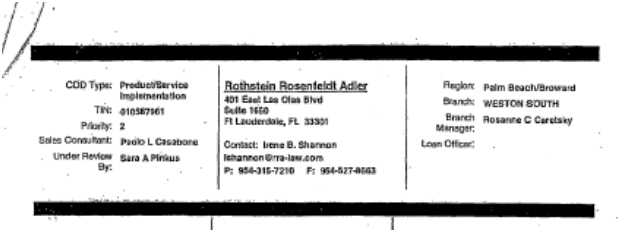
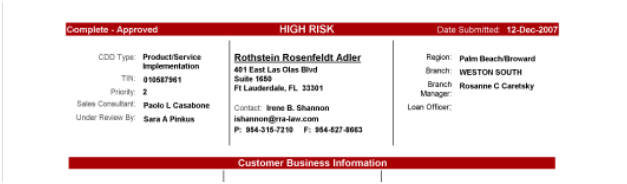
The form introduced at trial, on which TD Bank's anti-money laundering expert testified, had a simple black bar across the top. The true version of the form, which was obtained in another case by Coquina's lawyers at Miami's Mandel & Mandel after the trial, had "HIGH RISK" emblazoned across the top, highlighted in red.

Upon obtaining the true form, Mandel moved for sanctions, alleging that TD Bank had intentionally altered it. He said "the trial would have proceeded much differently had the defendant produced the true document." TD admitted the document was altered but blamed a clerical "copying error." It denied it had tampered with evidence to deceive the jury.

Mandel has asked Cooke to impose sanctions on the bank and Greenberg Traurig, including monetary penalties, referral of the bank to the Justice Department for criminal inquiry, and referral of the law firm to the Florida Bar for an ethics probe.

TD Bank admits to incorrect trial statements about "Standard Investigative Protocol"

TD Bank's recent withdrawal of court statements that it did not have a "Standard Investigative Protocol" outlining steps its anti-money laundering officers follow in customer due diligence investigations ups the stakes at the May 17 hearing before Judge Cook. The bank does not explain why the Protocol was not produced at trial.

According to court documents filed by Mandel, the Protocol first came to light in depositions by TD Bank's AML investigators. The bank did not produce the document and Greenberg Traurig lawyers told the court "there [were] no hidden documents regarding the investigative protocol."

Later, Greenberg lawyer Donna Evans told the court, "Mandel... seems to have created a document that doesn't exist, there is no document called 'Standard Investigative Protocol.'" A footnote in the bank's Notice of Substitution of Defense Counsel, which reveals its dismissal of Greenberg Traurig, mentions that Evans is no longer with the firm.

The veracity of these trial statements will probably be a central issue in the May 17 hearing before Judge Cooke. The bank's disclosure of the Protocol in its April 24 "Notice of Production and Withdrawal of Certain Statements Made to the Court" puts Evans' truthfulness in doubt. She is believed to have been the firm's "relationship partner" in the TD Bank representation, meaning she was the source of the bank's legal work.

In a comment to ACFCS, TD Bank spokesperson Rebecca Acevedo stated that "TD and Greenberg Traurig decided it was in the best interest of all concerned that McGuireWoods represent TD in the Coquina case moving forward." Mandel & Mandel declined to comment, and Greenberg Traurig could not be reached at the time of publication.

Paul Brinkmann of the South Florida Business Journal has led coverage on the dispute between TD Bank and Coquina Investments, and has broken several related stories.

Office of the Comptroller of the Currency has taken no action against TD Bank

The Office of the Comptroller of the Currency, TD Bank's principal United States federal regulator, has taken no action against the bank since the Rothstein megafraud exploded into public view in 2009.

Dean Debuck, a senior OCC spokesperson told ACFCS "We do not comment on ongoing litigation or supervisory matters involving a specific institution."

(The two versions of the top part of TD Bank's Customer Due Diligence Form for Rothstein's defunct law firm, Rothstein, Rosenfeldt and Adler, follow. The version presented in the Coquina case appears first, followed by the unaltered version.)

False Customer Due Diligence Form

TD Bank Customer Due Diligence Form

Read more: http://sivg.org/article/2012_TD_Bank_recants_testimony_fires_law_firm.html


Visit the Stanford International Victims Group - SIVG official forum http://sivg.org/forum/

Mittwoch, 18. April 2012

TD Bank says "copying error" caused altered document in fraud-money laundering case; but victim says that's nonsense

April 18, 2012
By ACFCS Staff
The case in which TD Bank has already lost a precedent-setting verdict for "aiding and abetting fraud" arising from collusion with one of its customers to defraud numerous persons and to launder the proceeds has taken an ugly turn.

A 70-day trial that ended in January produced a $67 million victory for Coquina Investments in its civil suit against TD Bank. Coquina was a victim of a megafraud perpetrated by TD Bank customer, Scott Rothstein, a convicted former lawyer now serving a 50-year prison term. The bank has appealed the verdict.

But now, TD Bank, one of the world's largest banks, confronts explosive post-trial charges that it produced a fraudulent piece of evidence at the trial that falsely hid its internal assessment that Rothstein and his firm were a "high risk" for money laundering.

The evidence, a 2009 TD Bank document called a "Customer Due Diligence" form, contained the findings of the pre-account opening inquiry by the bank of Rothstein's firm, Rothstein, Rosenfeldt and Adler.

Coquina Investments, the fraud victim that won the unprecedented verdict, alleged on March 26 that the bank perpetrated a "fraud on the court and jury" by hiding a red banner that contained the all-upper-case words "HIGH RISK."

The accusation, in the form of a motion for sanctions filed by Coquina's lead lawyer, David Mandel, of the Miami firm, Mandel & Mandel, alleges that TD Bank and its lawyers at Greenberg Traurig intentionally altered the form to keep the jury from seeing the official designation of Rothstein's law firm as "high risk."

TD Bank says altered form did not hurt plaintiff's case

TD responded to the accusation on April 12, denying any intention to mislead the jury. It said the alteration of the form resulted from a "copying error" by clerical staff and that Mandel knew of the high risk designation and stressed that to the jury in his closing argument. The bank said the altered form did not significantly influence the jury or change the trial's outcome, which was favorable to Coquina in any event.

Mandel countered with a strongly-worded reply on April 16, saying the bank's "response is tantamount to a continuing fraud on the court." He said TD Bank's explanation that its "copying process" was to blame for the doctored document "is not credible and can't be replicated."

He said "the trial would have proceeded much differently had the defendant produced the true document." Coquina's $67 million verdict included $35 million in punitive damages. Mandel had asked the jury to award $140 million in punitive damages.

With true form in hand, jury may have awarded higher damages

"Coquina is unfairly left to wonder what the jury's punitive damages award might have been if [TD Bank] had produced an unaltered version of the document before trial," says Mandel.

"The integrity of our judicial system demands that [TD Bank's] actions have consequences," he added.

Mandel said the bank not only introduced "the altered document into evidence," but also "affirmatively used it, both to cross-examine Coquina's expert and in closing argument." The bank, he says, "insisted that (Rothstein's firm) was a Low Risk customer" and berated Coquina's expert for asserting otherwise.

He alluded to a federal law at Title 18 USC, Section 1512(c)(1), which makes it a criminal offense to intentionally alter a document for use in a trial.

"Unreasonable" to believe alteration was accidental, Mandel says

The version of the Customer Due Diligence form the bank introduced in evidence had a simple black bar as a heading. Mandel says the true form, which he obtained in another case in which TD Bank is being sued, contains the words "HIGH RISK" emblazoned across the top, highlighted by a red background.

He says the alteration was so obvious and egregious that it had to be deliberate and that the misleading form propped up TD's defense that it knew nothing of Rothstein's fraud, did not help him perpetrate it and viewed his law firm as low risk.

"With tens of millions of dollars on the line, the Defendant asks the Court to believe... that it accidentally altered the document and presented it to the jury in a fashion that was undeniably misleading," says Mandel. He calls the argument "nonsense."

TD Bank denies bad faith

The bank's April 12 response denies it acted in "bad faith" and says changes to the form were unintentional by unnamed administrative staff.

The bank submitted a signed declaration by Sara Pinkus, a risk officer who had been asked to "gather customer due diligence records" to send to Greenberg Traurig for the trial. Pinkus says she printed the form and turned it over to an assistant for photocopying. The form was sent to the law firm, where a clerical assistant scanned the form and converted it to electronic format.

The bank says "the printing and copying process inadvertently blackened all of the words in all of the colored headers of the [form]," including the "HIGH RISK" designation.

Mandel calls this explanation "insufficient, inaccurate and potentially perjurious."

"Coquina attempted to replicate the Defendant's "copying process," but none of our efforts resulted in the words HIGH RISK being obscured from the document." he adds.

TD Bank declined requests for comment by ACFCS.org, citing its policy of not commenting on "pending litigation."

TD Bank says it "sincerely regrets this copying error," but contends that the obliterated "HIGH RISK" heading had no impact on Coquina's presentation at trial.

TD Bank's laundering expert testified Rothstein's firm was not "high risk"

TD Bank's response is silent on why Ivan Garces, who was TD Bank's anti-money laundering trial expert, testified that Rothstein was not a high-risk customer when its Customer Due Diligence form labeled him as such. Garces' had this colloquy at trial with a lawyer in Mandel's firm:

Coquina lawyer: Now is it - it's your opinion, sir, that TD Bank did not consider RRA [Rothstein's law firm] to be a high-risk customer of the bank; is that right?
Garces: Yes, ma'am. That's correct.
Coquina lawyer: It's not a high-risk customer.
Garces: It did not consider it a high-risk customer.

Mandel says in his new reply that "if the true document had been produced and entered into evidence..., it is hard to imagine anyone brazen enough to claim that [TD Bank] did not consider [Rothstein's law firm] to be a HIGH RISK customer."

Call for sanctions includes referral to Justice Department, Florida Bar

Mandel has requested that US District Court Judge Marcia G. Cooke impose a series of sanctions, including referring TD Bank to the US Department of Justice for criminal investigation and referral of Greenberg Traurig to the Florida Bar for review of possible ethical violations.

Judge Cooke, who presided over the long trial, has not yet acted on the motion, which requests sanctions.

The case offers many anti-money laundering and fraud control lessons to financial institutions. The experience of TD Bank also plants the seeds of headaches for financial institutions whose employee compensation plans include bonuses for attracting "assets under management."

(The two versions of the top part of TD Bank's Customer Due Diligence Form for Rothstein's defunct law firm, Rothstein, Rosenfeldt and Adler, follow. The version presented in the Coquina case appears first, followed by the unaltered version.)

False Customer Due Diligence Form

TD Bank Customer Due Diligence Form

Read more: http://sivg.org/article/2012_TD_Bank_says_copying_error.html


Visit the Stanford International Victims Group - SIVG official forum http://sivg.org/forum/

Freitag, 6. April 2012

Opposition to the USA's motion to dismiss the complaint

April 6, 2012
By Dr. Gaytri D. Kachroo
Plaintiffs hereby oppose the United States of America's Motion to Dismiss the Complaint (the "Motion"). This Court has subject matter jurisdiction over this action because the government fails to demonstrate that the discretionary function exception shields from liability the Securities and Exchange Commission's ("SEC") negligent failure to follow statutorily prescribed courses of action in the wake of its discovery of Robert Allen Stanford's Ponzi scheme.

The government's strategy on this Motion is to paint with a very broad brush. Thus, the government argues that "the manner in which the SEC chooses to regulate the securities industry" is discretionary conduct protected by the discretionary function exception in the Federal Tort Claims Act ("FTCA"), 28 U.S.C. § 2680(a). Generalized this way, the government's argument obviously cannot be contested. But framing the issue this way only creates a paper tiger. The conduct challenged in this case is not the SEC's regulation of the industry writ large, but rather its failure to comply with two specific, non-discretionary mandates. The government's over-generalization of the issue is an effort to move the battle to safer ground. This misdirection does not survive scrutiny.

Moreover, such a macro approach to the discretionary function exception results in the reverse of what Congress intended, which was to construe the remedial provisions of the FTCA liberally and the exceptions narrowly. If every claim against the SEC were to be construed as an attack on "the manner in which the SEC chooses to regulate the securities industry," then this narrow exception would swallow the general waiver and afford the SEC virtual immunity, contrary to Congress' intent. Indeed, as the government itself points out, Congress considered exempting the SEC from the FTCA entirely, but ultimately, did not do so.

Thus, the crucial first step in determining whether the exception applies is to isolate the specific conduct actually being challenged. Here, the Complaint does not make a broad attack on the manner in which the SEC regulates the securities industry, but rather, challenges two specific instances of SEC inaction: (1) a failure to notify the Securities Investor Protection Corporation ("SIPC") that U.S. registered broker-dealer Stanford Group Company "SGC") was in financial difficulty, after concluding that it was; and (2) a failure to deny continued registration to SGC as an investment advisor in light of the SEC's determination that SGC failed to satisfy registration requirements.

These negligent omissions violated statutorily mandated duties to take prescribed courses of action and thus, were not and could not have been permissible policy choices. As the Supreme Court has explained and courts have consistently held, where there exists a mandatory responsibility, there is no room for a policy choice. Moreover, even if the government could show that the SEC's negligent omissions involved the exercise of judgment, the government also fails to demonstrate, as it must, that such judgment was grounded in considerations of public policy.
Related documents:

Read more: http://sivg.org/article/2012_Opposition_USA_motion_to_dismiss_complaint.html


Visit the Stanford International Victims Group - SIVG official forum http://sivg.org/forum/

Donnerstag, 5. April 2012

Stanford Judge Lets Receiver Raise Fee, Retains 20% Discount

April 5, 2012
By Andrew Harris and Edvard Pettersson
The court-appointed receiver for R. Allen Stanford can bill his time starting this year at 2012 rates with a 20 per cent discount in spite of objections by Stanford investors who haven't received any money so far.

U.S. District Judge David C. Godbey in Dallas, in an order yesterday, imposed a 10 per cent "holdback" on out-of-pocket expenses. In a separate order today, Godbey approved the payment of $1.6 million in fees and expenses that the receiver, Dallas lawyer Ralph Janvey, had requested and said he could apply later for the held-back amount of $382,253.

Janvey's outside counsel, Kevin Sadler, argued at a hearing yesterday that the receiver's team has been working at the same pay rates since 2009. Sadler said that Janvey, who regularly charges his clients $500 an hour, has been billing $340 an hour on the Stanford case and then discounting that by 20 per cent.

A federal jury in Houston last month found Stanford, 62, guilty of fraud in what prosecutors said was a $7 billion scheme involving bogus certificates of deposit at his Antigua-based bank. He's scheduled to be sentenced on June 14. Janvey, whom Godbey appointed in February 2009 -- four months before Stanford was indicted -- and his outside professionals, including Baker Botts LLP (1143L), have been paid more than $52 million. That sum doesn't include a court-imposed $16 million hold-back.
RESPONSE OF THE OFFICIAL STANFORD INVESTORS COMMITTEE
The Official Stanford Investors Committee (the "Committee"), respectfully submits this Response to the Receiver's Motion for Approval of Request to Amend Fee Structure and Holdback [Doc. No. 1543].

The Committee, which speaks for the more than 20,000 investor victims of Allen Stanford's Ponzi scheme, opposes the relief requested by the Receiver and his team of professionals. The Receiver's professionals have been well compensated in the 3 years of this Receivership, having collected well in excess of $52 million in fees (with an additional almost $16 million in reserve via the holdback). During this same time period the investor victims have not recovered a single penny as there have been no distributions. Given the current state of this receivership, the Committee cannot agree to giving the Receiver's professionals what is widely perceived within the investor community as a "raise".

Therefore the Committee opposes the relief requested.
Related documents:

Read more: http://sivg.org/article/2012_Judge_Lets_Receiver_Raise_Fee.html


Visit the Stanford International Victims Group - SIVG official forum http://sivg.org/forum/

Freitag, 30. März 2012

TD Bank, lawyers accused of "fraud on court" for presenting false "Customer Due Diligence Form" in seminal AML civil case

March 30, 2012
By Brian Kindle
TD Bank, one of the world's largest financial institutions, is facing what may be the most explosive and damaging risk it has ever confronted. In a federal district court in Miami, it was accused this week of "working a fraud on the court and the jury" by doctoring a crucial document it presented in evidence at a recent trial it lost.

The accuser and winner of the recent trial, Coquina Investments, of Texas, says the false document gave the appearance that TD Bank officially considered its former customer, Scott Rothstein, as being "Low Risk," when, in fact, the true document it withheld from the court blared "HIGH RISK."

Coquina won landmark $67 million verdict against TD Bank in January

Coquina won an unprecedented $67 million jury verdict against TD Bank in January after a 2-1/2 month trial in Miami federal court before US District Judge Marcia G. Cooke. TD Bank was found liable by an eight-person jury of having "aided and abetted fraud" by helping Rothstein, a South Florida lawyer, to perpetrate a $1.2 billion fraud and to launder the proceeds.

It is believed to be the first case in history in which a bank has been held liable of "aiding and abetting fraud" for helping a customer execute a fraud and launder the proceeds.

Rothstein curried favor with bankers with gifts

Rothstein is serving a 50-year sentence in federal prison after pleading guilty in 2010 to the fraud and laundering. He is actively cooperating with federal agents and the bankruptcy trustee in the wide ranging, international case. His testimony has not spared his former Ft. Lauderdale law partners or the TD Bank officials who received his favors and gifts, including access to a hideaway pad in Ft. Lauderdale Rothstein stocked with wine and women.

TD Bank, through spokeswoman Rebecca Acevedo, told ACFCS, "We are vigorously opposing the motion and our opposition papers will be filed very shortly."

Lawyers for TD Bank, at Greenberg Traurig, did not respond to a request for comment.

OCC has been silent on TD Bank

The Office of the Comptroller of the Currency has been monitoring the case but has not taken any regulatory action against TD Bank in the 30 months since the Rothstein scandal broke.

Coquina's lawyer, David Mandel, of Mandel & Mandel in Miami, who is a former federal prosecutor, said on March 26 in the "Plaintiffs Fourth Motion for Sanctions" that TD Bank and Greenberg Traurig presented as evidence a Customer Due Diligence Form for Rothstein that had been stripped of a red banner that read "HIGH RISK" in bold letters. The comments "Complete-Approved" and "Date Submitted 12-Dec-2007" flanked the banner and were also missing in the version presented in the Coquina trial. The form documented that Rothstein had been found to be a high risk for money laundering activities based on certain factors, such as total monthly check deposits and cash activity.

The form also documented that TD Bank had performed "enhanced due diligence" procedures on Rothstein, including visits to his offices and a check of commercial databases.

These procedures are mandated by regulations issued by the Treasury Department's Financial Crimes Enforcement Network (FinCEN) under the US Bank Secrecy Act (Title 31 USC, Sections 5311 et seq.)

Coquina discovered true version of "HIGH RISK" form in related case

Mandel's motion says he discovered the "fraud" when, in a different but related case, TD Bank "produced a substantially different... Customer Due Diligence Form" for Rothstein. "Even a cursory examination of the recently produced documents [in the related case] shows that... [t]he document admitted into evidence in (the Coquina) case, is a fraud," the motion for sanctions continues.

The Customer Due Diligence Form that TD Bank presented in the other case was identical to the one it presented in the Coquina case except for the "HIGH RISK" banner at the top.

The new accusations by Coquina which were presented to Judge Cooke arise after TD Bank filed its appeal of the $67 million verdict with the 11th US Circuit Court of Appeals, in Atlanta.

The simultaneous appeal and allegation of falsified evidence puts a rarely-seen wrinkle in a civil case. Judge Cooke has ample remedies at her disposal, including the imposition of monetary penalties and the striking of pleadings, but she may feel constrained by the uncertainty of what the 11th Circuit Court may decide in the appeal of the main case. The appellate court is not officially aware of the new allegations by Coquina.

Another question is what effect the true Customer Due Diligence form may have had on the jury, which ruled in favor of Coquina anyway.

Coquina asks judge for referral to Justice Department and Florida Bar

An allegation of knowingly presenting falsified records in court is extremely serious and is usually dealt with harshly by a sitting judge. In its motion, Coquina asks Cooke to take three steps:

1) To sanction TD Bank "in the manner and extent that the Court deems just and appropriate,"
2) To refer TD Bank "to the Office of the United States Attorney for investigation of potential obstruction of justice charges,"
3) To refer "Defense counsel to the Florida Bar for investigation into what role, if any, Defense counsel had in this matter."

Whatever the outcome in the 11th Circuit Court of Appeals and before Judge Cooke on the Coquina motion, it is clear the tangible and intangible costs TD Bank incurs may end up being far greater than the $67 million a Miami federal jury found it should pay to the Texas investors in Rothstein's fraudulent Ponzi scheme.

(The two versions of the top part of TD Bank's Customer Due Diligence Form for Rothstein's now-defunct firm Rothstein, Rosenfeldt and Adler appear below. The version presented in the Coquina case appears first, followed by the unexpurgated version.)

False Customer Due Diligence Form

TD Bank Customer Due Diligence Form

Read more: http://sivg.org/article/2012_TD_Bank_accused_fraud_on_court.html


Visit the Stanford International Victims Group - SIVG official forum http://sivg.org/forum/